BIGNELL
The surname Bignell is recorded as having both English and French origins. The earliest instances of the name in England appear in the early twelfth century, notably in the Curia Regis rolls of Warwickshire where it is spelled Thomas de Bikenhulle in 1214.
According to scholarly tradition, the name is ultimately derived from the Old French word bien, meaning “good,” combined with the diminutive suffix -el. This formation suggests that the surname originally served as an occupational label, indicating a person who was skilled or proficient in their trade, and could be interpreted as “the good one” or “the skilled one.”
Simultaneously, the name is attested as a locational surname of Anglo‑Saxon origin. It derives from place names such as Bickenhall in Somerset and Bickenhill in Warwickshire. In the Domesday Book of 1086, Bickenhall is recorded as “Bichehalle” and in the 1243 Assize Court rolls as “Bikenhal,” meaning “Bica’s or Bicca’s hall” or “hill.” The personal name Bic(c)a is itself an archaic form of “becca,” a term for pick‑axe or mattock, combined with the Old English elements hyll (hill) or heall (hall). A comparable derivation applies to the Warwickshire settlement, recorded as “Bichehelle” in the Domesday Book and “Bykenhull” around 1220, signifying “Bic(c)a’s hill.” These locational surnames were typically adopted by individuals who had moved from their birthplace and were identified by that place’s name.
In the post‑Medieval period, several variants of the surname appeared, including Bicknell, Bignell, Bignall and Bignold. Church records from London provide notable instances of the name: a marriage entry for Thomas Bignell and Marie Hide at St. Gregory by St. Paul dated 30 January 1610 and a christening of Joseph, son of Robert Bignell, on 5 June 1636 at St. Mary Whitechapel, Stepney.
Heraldic evidence is also available: a grant of arms to a Bignell family depicts a red lion rampant on an ermine shield, with a blue chief bearing an ear of big‑wheat couped and bladed in gold between two silver estoiles. The blazon reflects the family’s prominence and the symbolic use of wheat denotes prosperity and cultivation.
Thus, the surname Bignell encapsulates a dual heritage: an occupational marker of skill derived from Old French, and a locational identifier rooted in Anglo‑Saxon place names of Somerset and Warwickshire. The name’s endurance through centuries of record‑keeping, surname variation, and heraldic recognition attests to its both linguistic and social significance within the British Isles.
Typical given names associated with the Bignell surname
Male
- Andrew
- Christopher
- David
- John
- Mark
- Michael
- Paul
- Peter
- Richard
- Stephen
Female
- Deborah
- Elizabeth
- Emma
- Helen
- Jacqueline
- Janet
- Julie
- Margaret
- Michelle
- Patricia
- Sarah
- Susan
- Victoria
Similar and related surnames
- Bignall
- Bagnell
- Bagnall
- Bicknell
- Bignal
- Bignel
- Bignill
- Bagenell
- Bagnal
- Bagnale
- Bagnel
- Bagnelle
- Bagnol
- Bagnoli
- Bagnoll
- Bagnulo
- Baignall
- Bainle
- Banal
- Banala
- Banall
- Banel
- Banell
- Baniel
- Banneel
- Bannel
- Bannell
- Baynall
- Begnall
- Begnell
- Benali
- Benall
- Benalla
- Benell
- Benella
- Benelli
- Benello
- Benli
- Bennall
- Bennel
- Bennell
- Bennill
- Benole
- Bignoll
- Bimnell
- Binall
- Binell
- Binelli
- Binnal
- Binnall
- Binnel
- Binnell
- Bisnell
- Bognolo
- Bohnel
- Bonali
- Bonall
- Bonallie
- Bonallo
- Bonel
- Bonell
- Bonella
- Bonelle
- Bonelli
- Bonellie
- Bonello
- Boniello
- Bonilla
- Bonillo
- Boniol
- Bonnal
- Bonnalie
- Bonnallie
- Bonnel
- Bonnell
- Bonnella
- Bonnelli
- Bonnello
- Bonollo
- Bounel
- Bounell
- Bownall
- Bownell
- Bugnall
- Bunal
- Bunall
- Bunel
- Bunell
- Bunill
- Bunnel
- Bunnell
- Bynall
- Bynell
- Biginelli
Related and similar names are generated algorithmically based on the spelling, and may not necessarily share an etymology.
How to communicate the surname Bignell in...
Braille
⠃⠊⠛⠝⠑⠇⠇
Morse
-.....--.-...-...-..
Semaphore
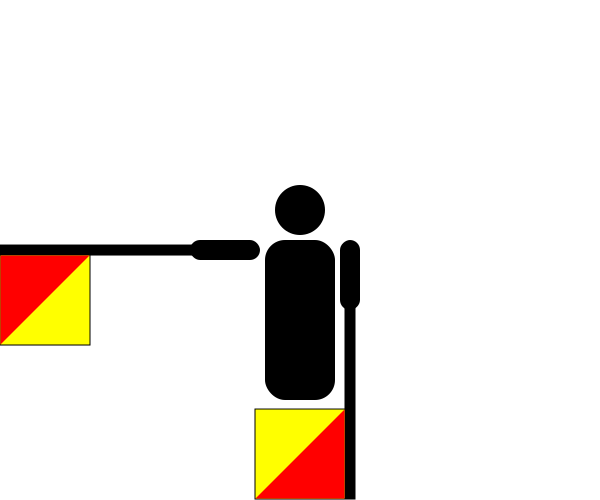
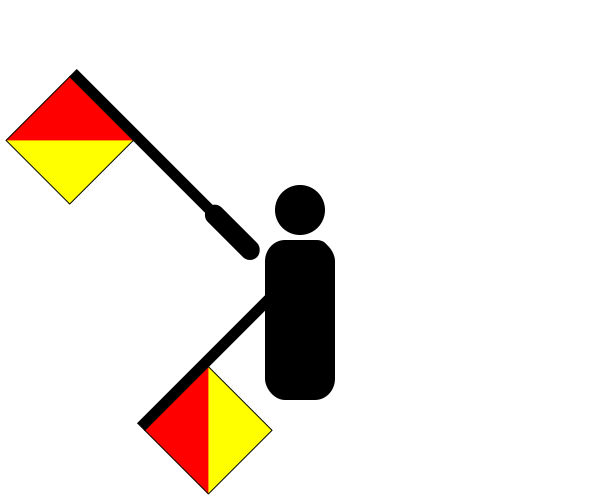

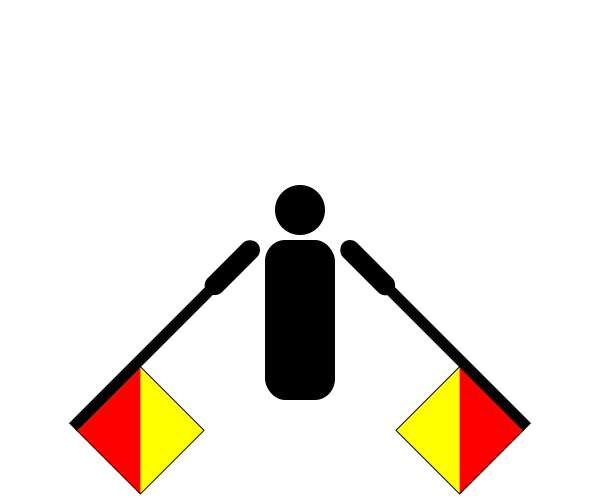


There are approximately 3,279 people named Bignell in the UK. That makes it roughly the 2,767th most common surname in Britain. Around 50 in a million people in Britain are named Bignell.
Surname type: Location or geographical feature
Origin: English
Region of origin: British Isles
Country of origin: England
Religion of origin: Christian
Language of origin: English

Famous people named Bignell
- Tony Bignell - Actor
- Guy Bignell - Cricketer (1886 to 1965)
Names and descriptions courtesy of Wikipedia, and may contain errors. This is not intended to be an exhaustive list of every famous person with this name.