BIER
Bier is a surname of Germanic origin that has been recorded across several parts of Europe and in the United States. The name is derived from the Middle High German word bier, which means “beer”, and it was originally an occupational surname given to those who brewed, sold or otherwise worked with beer. In some cases, it may have been employed as a nickname for a person with a strong affinity for beer or one who was closely associated with the beverage industry.
The surname also occurs in England, where it is thought to be a variation of the Old English words byre or by, meaning a cattle barn or dairy. This topographical form was used for people who lived or worked on farms, especially in the cattle‑breeding regions of East Anglia and the West Country. Early English records include Elias de la Byare of Devonshire in 1275, Thomas filius Bye of Cambridge in 1279, and John Buyres of Somerset in 1327. The name appears in the Cambridge Hundred Rolls and in the 1327 Subsidy Tax rolls.
In Germany, the earliest surviving references to the Bier surname date from the 15th century, where it is mentioned in court cases within the dukedom of Franconia. By 1568 the Bier family had begun acquiring estates around Hanau and Fulda, and later the family expanded to other parts of Europe, including the Netherlands, France and Denmark. The surname remains most common in Germany, with the highest concentrations in Bavaria, Rhineland‑Palatinate and North Rhine‑Westphalia. It is also well represented in Austria, Switzerland and the Netherlands.
Anglicised versions of the name, such as Beer, Bieren and Beeren, can be found in the United Kingdom and in the United States, where the surname was brought by German and Swiss immigrants during the 19th and 20th centuries. In the United States there are approximately 12,000 individuals bearing the surname, with the largest populations in Illinois, California, New York, Massachusetts, Pennsylvania and Texas.
The surname has several recognised variants, including Byars, Byers, Byre, Byres, Biers and Buyers in English contexts, and Beyer, Bayer, Bär, Baehr, Beier and Bähr in German. In Dutch contexts it may appear as Bier, Beyer or Bijer, while in East Prussia it was historically spelt Beyer or Beur. These spelling differences often provide clues to the geographical origins of a family line.
Today the Bier surname remains a common feature across many regions of Europe and is also represented in Australia, New Zealand, South Africa, the former Soviet Union and parts of the Middle East, reflecting both its Germanic roots and the historic movement of peoples throughout the world.
Similar and related surnames
- Baehr
- Baer
- Bahr
- Bahra
- Bair
- Baira
- Baire
- Bairo
- Bairs
- Bar
- Bare
- Barr
- Barre
- Bear
- Beare
- Beer
- Beere
- Beeri
- Beers
- Beery
- Behr
- Behre
- Beir
- Beira
- Beire
- Beiro
- Beirs
- Beor
- Ber
- Bera
- Bere
- Beri
- Bero
- Berr
- Berre
- Berrie
- Bers
- Berz
- Beure
- Biar
- Bie
- Biera
- Bierd
- Bieri
- Biers
- Biery
- Bior
- Bir
- Bira
- Bire
- Bires
- Birgh
- Biri
- Birk
- Biro
- Birr
- Birre
- Birri
- Birro
- Birrs
- Birs
- Biry
- Boar
- Boor
- Bor
- Bore
- Boree
- Borr
- Borrie
- Bour
- Bower
- Bowers
- Broe
- Bur
- Bure
- Burr
- Byer
- Byers
- Iber
Related and similar names are generated algorithmically based on the spelling, and may not necessarily share an etymology.
How to communicate the surname Bier in...
Braille
⠃⠊⠑⠗
Morse
-.......-.
Semaphore
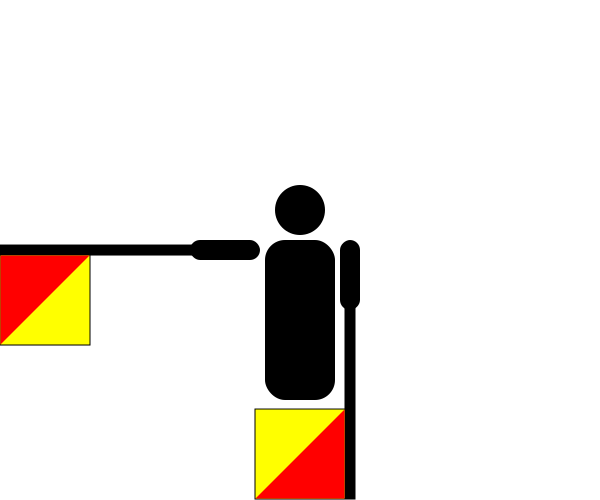
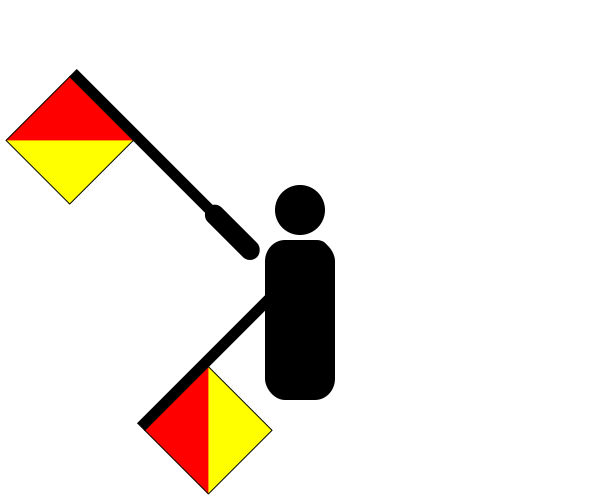

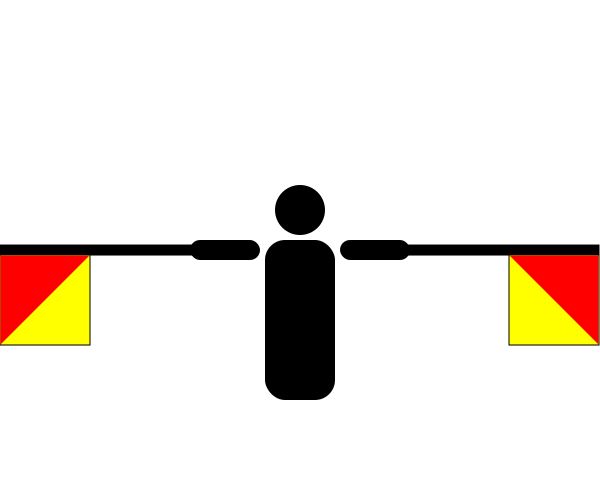
There are approximately 86 people named Bier in the UK. That makes it one of Britain's least common surnames. Only around one in a million people in Britain are named Bier.
