BEYER
The surname Beyer is principally of German provenance, having evolved in the Middle High German language as an occupational designation. In medieval usage it was employed to identify a person appointed as a bailiff or administrator responsible for the management of a local estate or area. The word beyer in Middle High German directly conveyed this role, and consequently the name was adopted as a family surname for those who held such offices.
In addition to its civil administrative sense, the same spelling was also found in contexts where it denoted a bearer or pall‑bearer, deriving from the Middle High German bier. Here the term was applied to individuals engaged in carrying goods, messages or, in a more literal sense, livestock. Because of the multiple occupational roots, the name can also be associated with the bear in various metaphorical or literal contexts such as a bear‑keeper or an inhabitant of an area frequented by bears.
Historical records attest to the early use of the surname in England. An early variant, Simon le Beier, appears in the The Hundred Rolls of Gloucestershire for the year 1273, during the reign of King Edward I. The name is also documented as John le Beyere in the same century in the The Hundred Rolls of Hertfordshire (1292). In the mid‑17th century, a couple registered a marriage under the spelling Byer in London (Katherine Byer married Henry Pavill on 14 June 1648, St. Bartholomew the Less). Later baptisms in the latter half of the 18th century record the name in various forms: Elizabeth Frances Beyer (1772, St. Vedest, Foster Lane), Anne Beyer (1764, St. Anne Soho, Westminster). These entries confirm the establishment of the surname within English society while retaining a distinctly Germanic orthography.
Geographically, the name is linked to Bavaria (Bayern) in southern Germany, a region whose name itself arises from the Celtic tribe of the Boii that settled there before being displaced in the sixth century by a Germanic group derived from the Marcomanni. Consequently, some branches of the surname are considered to be in origin from Bavaria, leading to variants such as Bavarian or Bayern that reflect patient regionalisation.
The spelling of Beyer has produced a range of alternatives across dialects and national borders. Forms such as Bayer, Baier, Beier, and Beye are documented in German records, while Byer and Byer‑Smith appear increasingly in the United States following waves of German emigration. Within the Jewish community, the surname has Ashkenazic roots, and it is found among Jewish families in several European countries. The diverse orthographies demonstrate how regional pronunciation, literacy levels, and clerical transcription have influenced the modern distribution of the name.
Overall, the surname Beyer represents a multifaceted historical identity rooted in German occupational nomenclature, extended through medieval civil administration, and further diversified by regional linguistic influences. Its persistence in English parish records and contemporary German documentation illustrates a long-standing transnational presence that continues to be recognised today.
Typical given names associated with the Beyer surname
Male
- Anthony
- Arthur
- Christopher
- David
- Holger
- James
- John
- Mark
- Michael
- Oliver
- Paul
- Peter
- Richard
- Stephen
Female
- Andrea
- Anna
- Barbara
- Charlotte
- Jacqueline
- Jessica
- Julia
- Kathleen
- Mary
- Nicola
- Patricia
- Ruth
- Sally
- Susan
Similar and related surnames
Related and similar names are generated algorithmically based on the spelling, and may not necessarily share an etymology.
How to communicate the surname Beyer in...
Braille
⠃⠑⠽⠑⠗
Morse
-....-.--..-.
Semaphore
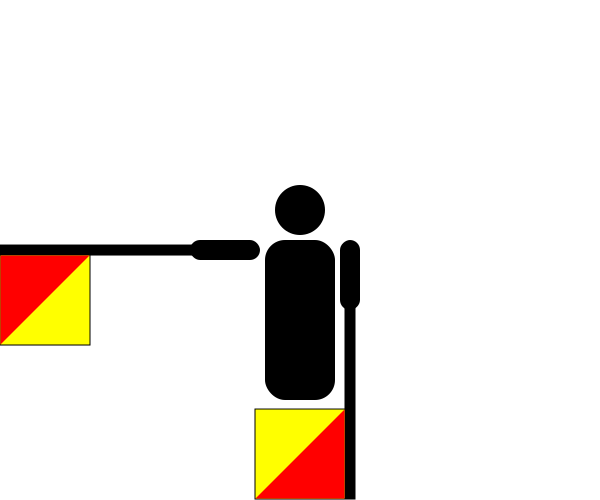

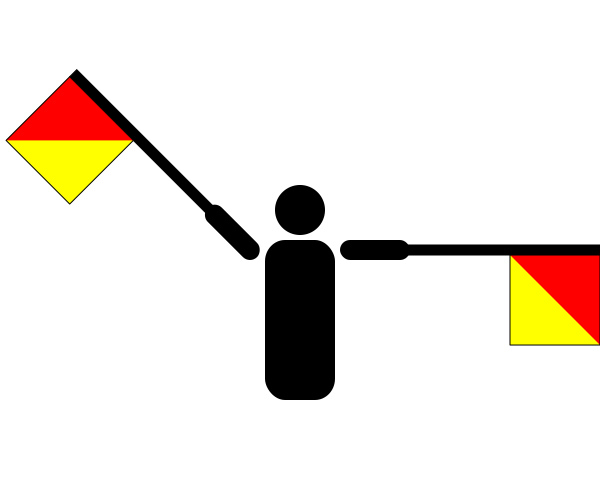
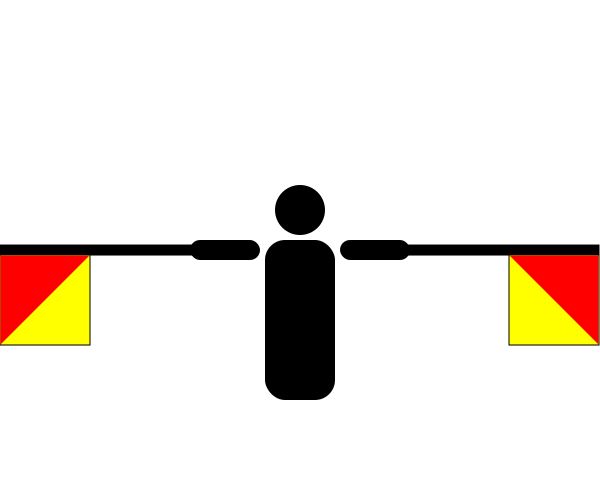
There are approximately 422 people named Beyer in the UK. That makes it one of Britain's least common surnames. Only around six in a million people in Britain are named Beyer.
Origin: English
Region of origin: British Isles
Country of origin: England
Religion of origin: Christian
Language of origin: English
