BELLINGHAM
The surname Bellingham is firmly rooted in England, deriving from an Old English locational name. It is first recorded as Belingham in the –*Hundred Rolls* of Norfolk in 1273, a period when the Domesday survey and royal tax rolls were establishing a national bureaucratic record. The place name itself is a combination of the elements belle or bellinge, meaning a bell or a bell‑shaped hill, and ham, denoting a homestead or village. Consequently the toponym has often been rendered as “the homestead at the bell” or “the bell‑hill settlement.”
Later linguistic studies, however, have produced a range of interpretations for the first element. In one account it is linked to the Old English word belling, “loud” or “boisterous”, suggesting an informal description of a lively or noisy hamlet. In another, the component is linked to the personal name Beli or Beoera, meaning “bear”, which would have yielded a meaning such as “the homestead of Beli’s people”. A further hypothesis, drawn from Chaucer‑era documents, proposes that the name could denote “the homestead where beehives or beans were abundant”. These multiple readings illustrate the way early place names were often re‑interpreted as linguistic knowledge evolved.
Early documentary evidence shows the surname appeared across a wide swathe of England during the Middle Ages. The Feet of Fines record a John de Belneham holding land in the Diocese of Durham in 1275, while later entries locate bearers of the name in Lancashire, Derbyshire, Shropshire, Cambridge and London. By 1588 a Richard Bellingham of Sussex is mentioned in the Oxford University register. The name even surfaced in southern England, with a manor near Hastings, Belingeham, cited in the Domesday Book and later noted by M. A. Lower in his biography of English families.
In the nineteenth century the surname attained a concentration in the north‑west of England. The 1881 census recorded 3,288 individuals bearing the name, predominantly in Cheshire and Lancashire. The name also crossed the Irish Sea, with clusters in Ayrshire, Scotland, and in the newly formed United States of America, where English emigration in the eighteenth and nineteenth centuries introduced a substantial number of Bellinghams to the North American continent. Queen‑ic evidence now places the surname in Canada, Australia, and various other parts of the former British Empire, a testament to the continued spread of the family name through migration.
Official heraldic records show that a family of Bellinghams received a coat of arms featuring a gold shield and a black bugle‑horn, garnished in silver, on a twisted gold branch with blue and green leaves. The painted motto, “Ainsi il est”, translates as “Thus it is”. Although the precise relationship between the heraldic beings and the modern surname bearers is not always clear, the existence of the arms suggests a degree of social distinction attained by an early branch of the family.
The surname produces a number of orthographic variants that appear in historical and regional documents. These include Bellingam, Belingeham, Belingham, Bellingan, Belinham, and Belligham. The comparatively more exotic spellings such as Mac Bellingham trace back to Gaelic patronymics and the influence of Scottish immersion, while the forms Belan and Bellan are found in Ireland as anglicised derivatives of the surname Ó Bealan. In Wales the name appears as either Belingham or Bellingham and is interpreted as an anglicised form of the personal name Beli.
Today the surname Bellingham remains a common element of the British onshore population, particularly in Great Britain and Ireland. It continues to be recorded in the United Kingdom, the United States, Canada, Australia and Ireland, reflecting both the historic migration of English families and the diaspora of the British people more generally. While the meaning of the surname has evolved through centuries of linguistic change, its origin as a locational identifier from a bell‑shaped hill or a homestead of the people of Beli remains an essential part of its historical identity. Thus the name stands as a lasting reminder of the peoples and places that gave rise to a distinct family lineage within the tapestry of English history.
Typical given names associated with the Bellingham surname
Male
- Andrew
- David
- James
- John
- Mark
- Paul
- Peter
- Richard
- Robert
- Roger
- Stephen
Female
- Claire
- Jane
- Joan
- Julie
- Kathleen
- Linda
- Margaret
- Mary
- Sarah
- Sharon
- Susan
Similar and related surnames
- Billingham
- Ballingham
- Balling
- Ballinger
- Ballinghall
- Ballingar
- Ballingal
- Balinga
- Ballingale
- Ballingall
- Beling
- Belinga
- Belingham
- Belligham
- Belling
- Bellingall
- Bellingan
- Bellinge
- Bellinger
- Bellinghall
- Bellingor
- Bellings
- Bilingham
- Billinghame
- Bollingham
- Bullingham
- Ballings
- Bealing
- Beeling
- Behling
- Belinger
- Bellinghausen
- Bellingy
- Bieling
Related and similar names are generated algorithmically based on the spelling, and may not necessarily share an etymology.
How to communicate the surname Bellingham in...
Braille
⠃⠑⠇⠇⠊⠝⠛⠓⠁⠍
Morse
-.....-...-....-.--......---
Semaphore
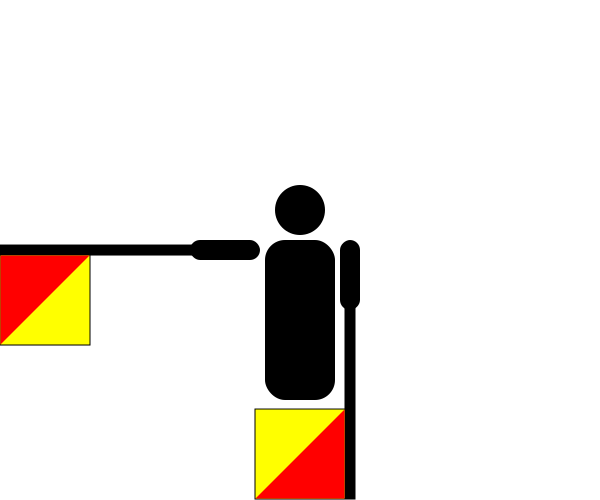


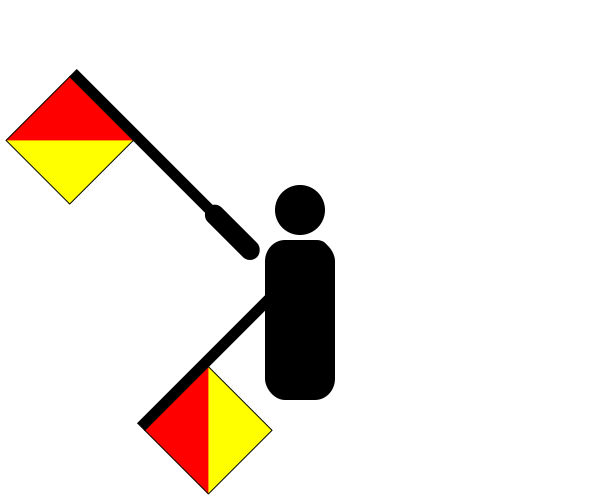
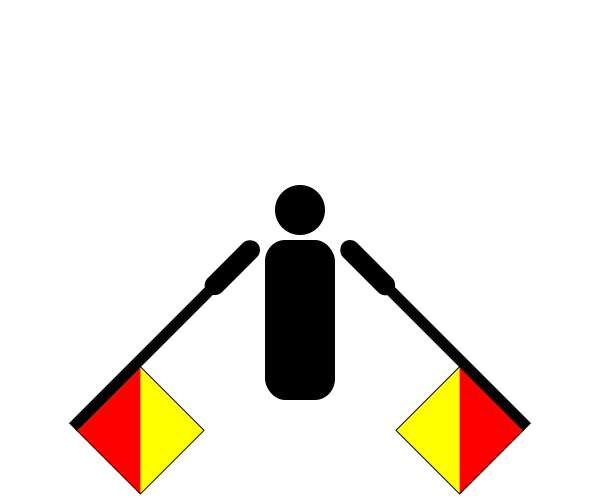


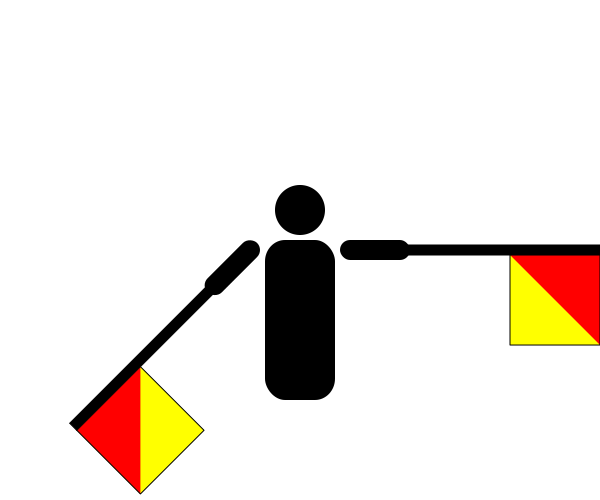
There are approximately 2,016 people named Bellingham in the UK. That makes it roughly the 4,192nd most common surname in Britain. Around 31 in a million people in Britain are named Bellingham.
Surname type: Location or geographical feature
Origin: English
Region of origin: British Isles
Country of origin: England
Religion of origin: Christian
Language of origin: English

Famous people named Bellingham
- Lynda Bellingham - Actress (1948 to 2014)
- Jude Bellingham - Football player
- Henry Bellingham - Politician
- Elinor Bellingham-Smith - Painter of landscapes and still life (1906 to 1988)
- Alastair Bellingham - Haematologist (1938 to 2017)
- Sir Edward Bellingham, 5th Baronet - Army general (1879 to 1956)
Names and descriptions courtesy of Wikipedia, and may contain errors. This is not intended to be an exhaustive list of every famous person with this name.