BELLENGER
Bellenger is a surname of French provenance, with a documented presence in England following the Norman Conquest of 1066. It is first recorded in contemporary charter material as a hereditary family name that passed from one generation to the next.
The name is traditionally analysed as a composite of the Old French elements bel, meaning “beautiful”, and ange, meaning “angel”. In this construction the surname would have been a descriptive nickname for an individual considered exceptionally beautiful or angelic in appearance or moral character, a utilisation that was common in medieval onomastics.
Alternate scholarship interprets Bellenger as an occupational surname, derived from Old French boulenger – a term for a baker. In this view the name would have been applied to persons whose principal occupation involved baking, an occupation status that was frequently memorialised in surnames across medieval Europe. The existence of other locational hypotheses, such as a derivation from a field or meadow, is acknowledged, though the prevailing academic consensus supports the occupational theory.
Bellenger also appears in records as a variation of the Norman personal name Berengier or Berenger, introduced into England by the Norman elite. The personal name itself has Germanic roots, combining the elements ber(n) “bear” and ger “spear”. The Domesday Book of 1086 records the name as Berengerus, while 12th‑century documents record forms such as Belingar (1207) and Berenger (1219). Early hereditary bearers are noted in the 12th and 13th centuries – for instance Walter Beneger (1208, Gloucestershire), Reginald Beringer (1260, Cambridgeshire) and John Belinger (1275, Worcestershire).
The modern spelling Bellenger has evolved through a range of variants, including Beringer, Berringer, Bellinger, Ballinger, Benninger, Benger and Bellanger. Prefixes such as de or le have occasionally been affixed, producing forms like de Bellenger or Le Bellenger, which literally translate to “of Bellenger” or “the Bellenger”.
Today the surname, while not among the most common, is represented in a number of English‑speaking countries, notably in France, the United Kingdom, the United States, Canada, Australia and New Zealand. These distributions reflect both historic migration patterns and modern demographic spread, rather than indicating a single line of descent.
Overall, the Bellenger surname offers a rich illustration of the ways in which personal attributes, occupational status and inherited lineage have intertwined in the formation of family names across the centuries. The surviving evidence firmly roots the name in French origin, with a traceable passage into English society and a multiplicity of historical variants that continue to be used by contemporary families.
Typical given names associated with the Bellenger surname
Male
- Adam
- Andrew
- David
- Dominic
- Freddie
- John
- Michael
- Nicholas
- Nigel
- Paul
- Peter
- Simon
Female
- Amanda
- Elizabeth
- Emma
- Hilary
- Jane
- Karen
- Linda
- Nicola
- Sarah
- Sylvia
Similar and related surnames
Related and similar names are generated algorithmically based on the spelling, and may not necessarily share an etymology.
How to communicate the surname Bellenger in...
Braille
⠃⠑⠇⠇⠑⠝⠛⠑⠗
Morse
-.....-...-...-.--...-.
Semaphore
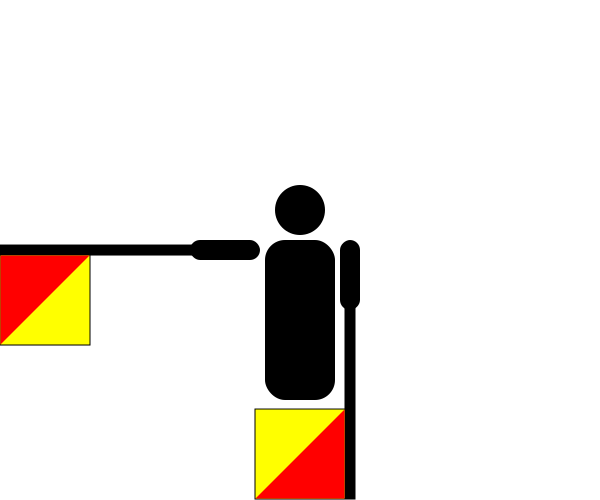


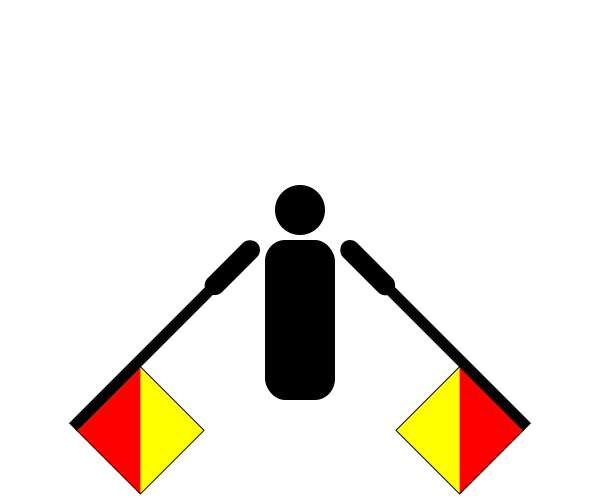

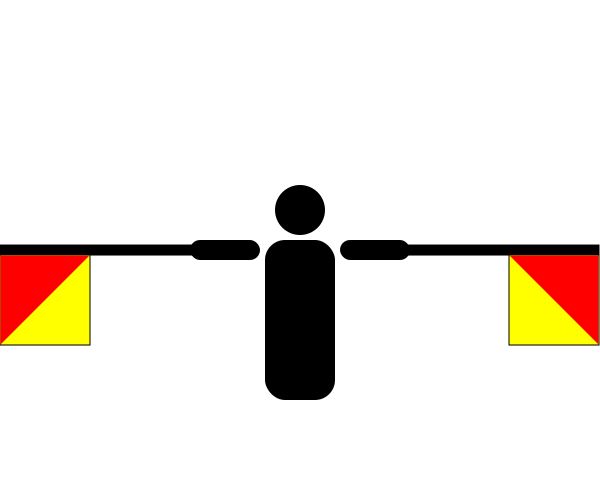
There are approximately 208 people named Bellenger in the UK. That makes it one of Britain's least common surnames. Only around three in a million people in Britain are named Bellenger.

Famous people named Bellenger
- Frederick Bellenger - Politician (1894 to 1968)
Names and descriptions courtesy of Wikipedia, and may contain errors. This is not intended to be an exhaustive list of every famous person with this name.