BEAVIS
Beavis is a surname of English origin that incorporates French and Germanic etymological roots. The name first appears in England in the late eleventh century, following the Norman Conquest, and has been in continuous use ever since.
The medieval personal name Bevis is the source of the surname. Bevis itself is derived from the Old French name Beuve, which in turn is thought to descend from the Germanic word boeve, meaning “bright” or “shining”. Consequently, Beavis can be understood as signifying someone who is bright or shining in character or appearance.
Evidence for the presence of the name in England is found in the Domesday Book of 1086, a survey commissioned by King William the Conqueror to assess taxable assets. This document records the name under a form that suggests the early adoption of the surname by Norman settlers during the period that followed the conquest of 1066.
Subsequent records attest to the spread of the name in medieval England. In London, a Simon de Beauveys is mentioned in 1292, while a Robert de Beueys is recorded in Cambridgeshire in 1327. A Charles Beavis appears in the “Oxford University Register” of 1614 within the county of Devon, indicating the enduring usage of the name across generations.
Several variant spellings of the surname exist, most of which are of French origin. These include Be(a)ves, Be(e)vis(s), Beauvais, Bovis and other combinations. Locational origins are also recognised, notably from the town of Beauvais in the Oise department of France, a settlement that was itself named after the Gallic tribe known as the Bellovaci. Other French place names derived from the late Latin phrase bellum visum (lovely sight) may likewise have contributed to the development of the surname in England.
In addition to locational derivations, the name may also stem from the Old French phrase bel fi(l)z, composed of beu or bel meaning “fair” or “lovely” and fi(l)z, meaning “son”. This affectionate nickname could have been applied to a favoured individual, as suggested by the records of Odo Belfiz (Hampshire, 1176) and William Beaufiz (Gloucestershire, 1208).
A notable historical figure associated with the name is the Norman knight Bevis of Hampton, who appears in early Arthurian romances. While the precise lineage of modern bearers of the surname is uncertain, this association indicates that the name may have been adopted by families who claimed descent from this celebrated knight.
Within the United Kingdom, the surname is most frequently encountered in the eastern counties. Early references to Beavis families in the East Anglia region date back to the late tenth and early eleventh centuries. Census records from 1881 show that the highest concentrations of the surname were in Norfolk and Lincolnshire. In contemporary practice, electoral rolls still indicate a notable clustering of individuals with the surname in East Anglia and the Home Counties.
In the United States, the surname is considerably rarer but can be found across the country, with the largest group residing in New York. The American presence reflects migration patterns from the United Kingdom but remains a fraction of the number of bearers in Britain.
The full range of spelling variants demonstrates the fluid nature of early record-keeping and the adaptation of the name to regional dialects. Variants such as Beaviss, Beavise, Beavises, Beviss, Bevise, Bevises, Beavisses, Beavesses, Beavisse, Beanis, Bevens and Bevans are all recognised as stemming from the same etymological root. This breadth of forms illustrates the widespread adoption of the name and its integration into English nomenclature over several centuries.
Overall, the surname Beavis exemplifies a lineage that intertwines Norman influence with deeper Germanic roots, achieving a lasting presence within British genealogical history. Its enduring usage and the persistence of historical records attest to the cultural and social significance of the name across time and geography.
Typical given names associated with the Beavis surname
Male
- Alan
- Andrew
- Christopher
- David
- James
- John
- Mark
- Matthew
- Michael
- Paul
- Richard
Female
- Caroline
- Elizabeth
- Hannah
- Joanne
- Julie
- Kate
- Linda
- Margaret
- Mary
- Patricia
- Sarah
- Susan
Similar and related surnames
Related and similar names are generated algorithmically based on the spelling, and may not necessarily share an etymology.
How to communicate the surname Beavis in...
Braille
⠃⠑⠁⠧⠊⠎
Morse
-.....-...-.....
Semaphore
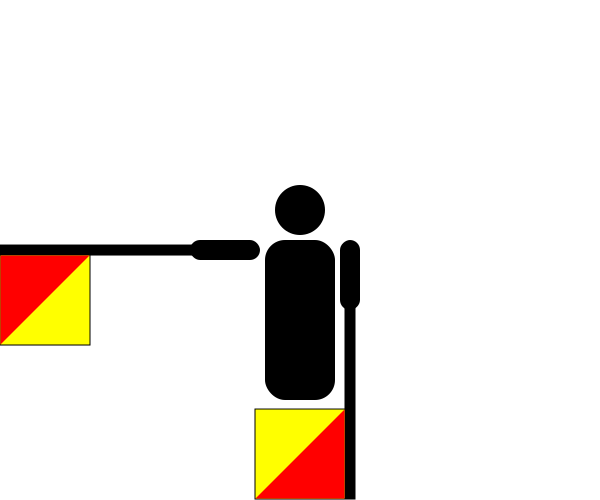


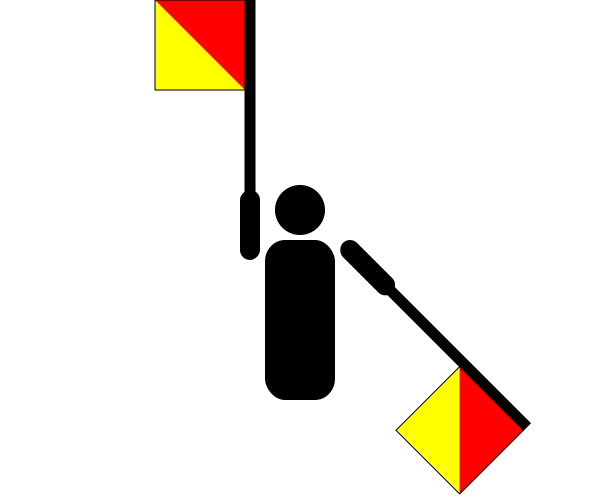
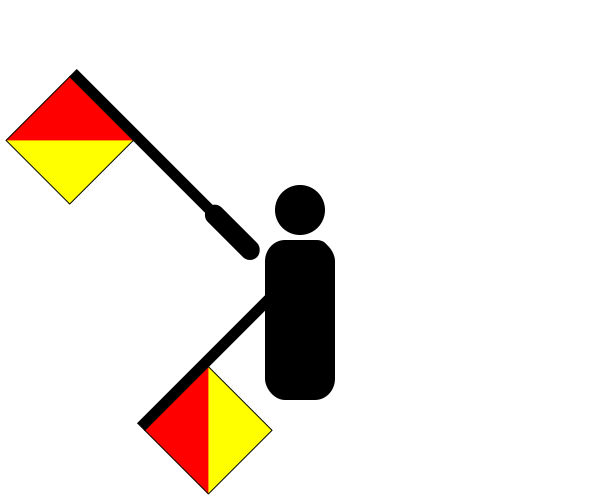

There are approximately 2,406 people named Beavis in the UK. That makes it roughly the 3,614th most common surname in Britain. Around 37 in a million people in Britain are named Beavis.
Origin: English
Region of origin: British Isles
Country of origin: England
Religion of origin: Christian
Language of origin: English
