BEAVERS
Beavers is a surname of strictly English origin, first recorded in the British Isles during the early medieval period. It is almost universally recognised as a patronymic name that emerged within England, with a substantial body of documentary evidence supporting this national provenance.
The name is derived from the Old English term beofor, meaning “beaver”. In the Middle Ages it was used either as a descriptive nickname for an individual who resembled a beaver in some physical or behavioural way, or as an occupational designation for a trader of beaver pelts, the furs of which were highly valued for their waterproof qualities. The use of such occupational or characteristic surnames was common during the Norman and early Plantagenet era.
Alternative etymologies recognise the existence of a small number of “Beavers” families whose surname originates from the Norman French placename Belvoir, a locational surname taken from a number of villages in France such as Beauvoir in Manche, Somme and Seine‑Maritime, or from the similarly named settlement in Leicestershire. The French elements beu, bel meaning “fair, lovely” and voir meaning “to see” combine to give a translation of “a place with a fine view”. These locational variants are recorded in the early 12th century in Yorkshire court rolls.
The first documented instance of the surname appears as Godwyn Beure in 1084, in the Early London Personal Names collection. This record dates to the reign of William the Conqueror, 1066‑1087. Further attestations include Ralph de Belueeir (1170) in the Pipe Rolls of Yorkshire and John de Baauveir (1204) in the Assize Court Rolls of Yorkshire. By the sixteenth and seventeenth centuries church registers contain several baptisms under the spelling “Beaver” or “Bever”, for example Ann Beevor (Christened 22 January 1562, St. Dunstan in the East, London) and Elizabeth Beaver (Christened 28 May 1637, St. Giles, Cripplegate, London).
In contemporary times the surname remains most common in the United States, particularly in the southern states of Texas, Ohio and California, according to recent forebears statistics. Pockets of the name can also be found in Canada, Australia, New Zealand, Ireland and, of course, the United Kingdom, albeit in considerably smaller frequencies outside the United States. The name’s prevalence in the United States stems largely from the migration of English families during the 18th and 19th centuries.
There exists a wide variety of spelling variants, all recognised as cognates of the modern surname. Variants include Beaver, Beever, Beevor, Bevar, Bever, Bevir, Biever, Beavors, Beavour, Beor and others such as Beaver, Beavors and Beavure. These differences are attributable to regional pronunciation, phonetic transcription and the lack of standardised spelling before the modern era. The existence of such variants illustrates the dynamic nature of surname development and the independent evolution of families bearing the same base name.
Typical given names associated with the Beavers surname
Male
- Alan
- Andrew
- Anthony
- Christopher
- David
- James
- John
- Mark
- Paul
- Richard
- William
Female
- Deborah
- Denise
- Elizabeth
- Gillian
- Joanne
- Julie
- Karen
- Laura
- Margaret
- Michelle
- Nicola
- Samantha
- Sarah
- Susan
Similar and related surnames
Related and similar names are generated algorithmically based on the spelling, and may not necessarily share an etymology.
How to communicate the surname Beavers in...
Braille
⠃⠑⠁⠧⠑⠗⠎
Morse
-.....-...-..-....
Semaphore
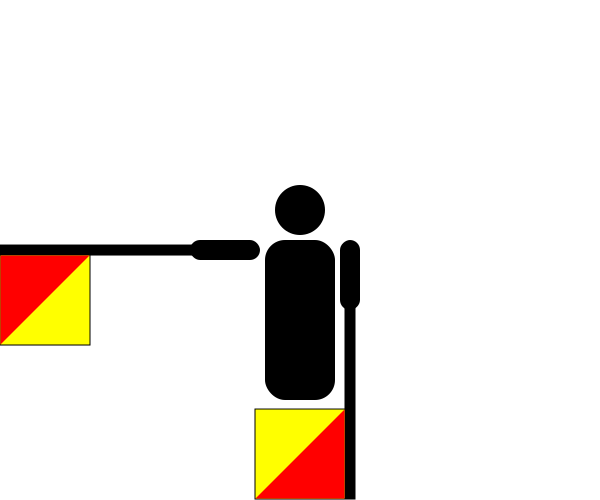


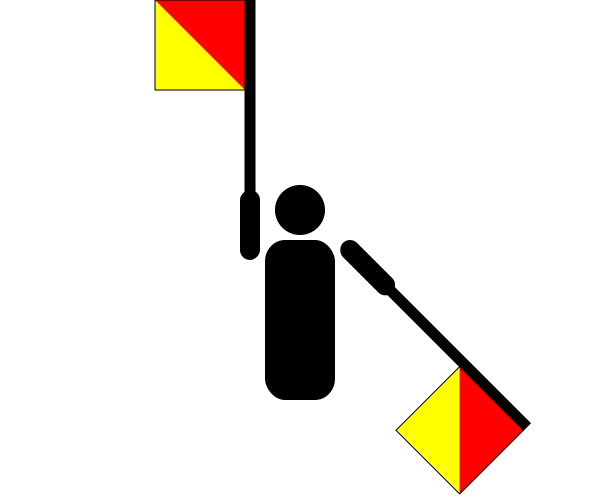
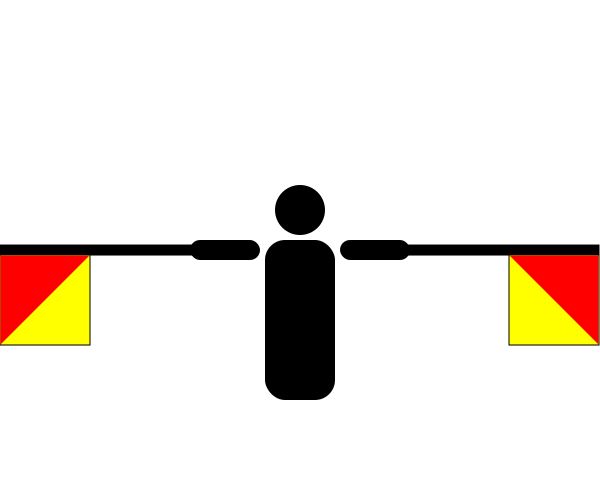

There are approximately 679 people named Beavers in the UK. That makes it roughly the 9,916th most common surname in Britain. Around ten in a million people in Britain are named Beavers.
Origin: English
Region of origin: British Isles
Country of origin: England
Religion of origin: Christian
Language of origin: English

Famous people named Beavers
- Wally Beavers - Long-distance runner (1903 to 1965)
Names and descriptions courtesy of Wikipedia, and may contain errors. This is not intended to be an exhaustive list of every famous person with this name.