BASTEN
Background and Etymology
The surname Basten has a dual heritage that can be traced to both Dutch and Latin roots. In its earliest usage it functioned as a patronymic, denoting the descendants of an individual named Sebastian. The name Sebastian itself is derived from the Latin Sebastianus, which means “from Sebaste,” a city in Asia Minor that was considered a holy place. Consequently, the surname carries associations with personal qualities traditionally attributed to those named Sebastian, such as devotion, strength and honour.
Historical Variants and Roman Influence
Historical records show that the name evolved into more than seventy different forms, including Sebastian, Bastian, Paustian, and diminutives such as Bast and Sebok. In addition, patronymic derivatives like Bastien, Baston, Basting and Bestages appear across Europe, granting the name a wide geographical reach. The diversity of spellings reflects its Roman origins, as the original personal name Sebastianus was widespread during the pre-Christian period. The name's locational aspect was conferred by the term “Sebastos,” implying reverence or sanctity, and early bearers of the name were often considered holy men, a notion supported by the prominence of St. Sebastian, who was martyred in Rome in the third century as a praetorian guard preaching Christianity.
The name gained further traction in the wake of the Crusades. Returning soldiers and pilgrims frequently adopted Biblical or Greek names in honour of their faith and travels. In northern Europe, the popularity of names such as Matthew, Mark, Luke, John and, in this case, Sebastian reflected this cultural trend. The first definitively recorded use of the form Bastian in England is associated with John Bastian, documented in the county of Kent in 1317, while a Latinised form, Liborius Sebastiani, appears in the charters of Rochlitz, Germany, in 1490.
Germanic Roots and Occupational Connotations
In German usage, the surname Basten is believed to have evolved from the ancient Germanic personal name Bastjan, a compound of “bast” (meaning rod, staff or club) and “jan” (meaning God is gracious). This derivation suggests that the name could have functioned as an occupational marker for artisans who produced wooden implements such as clubs, staves or walking sticks, or alternatively as a nickname for people of notable physical strength, symbolised by the metaphor of a staff.
The earliest recorded German use of Basten dates to 1422 in Lower Saxony, where a Johannes Basten appears in contemporary documents. Over time, the name spread across Germany, yielding variants such as Baster, Bastery, Bastert, Basterd and Bastean. Today, the surname remains most common in Germany, with more than 21,800 individuals bearing the name, making it the 52nd most frequent surname in the country. It is concentrated in the state of North Rhine-Westphalia and particularly in the cities of Duisburg, Oberhausen and Duisburg‑Ruhrort.
Distribution in the Modern Era
In addition to its prevalence in continental Europe, the surname Basten is found in the United States, Australia, Brazil and the Netherlands. According to the 2010 United States Census, the name is held by a little over 1,600 people, a figure that reflects significant Dutch heritage in the Midwestern states among American bearers of the name. In the Netherlands, the surname ranks as the 139th most common, with nearly 5,500 individuals. The concentrations outside Germany remain comparatively modest, although they are nevertheless noteworthy, particularly in small communities that retained the name through generations of immigration.
Conclusion and Legacy
The surname Basten exemplifies the complex interplay between personal, occupational and geographical identities across European history. Whether derived from the Roman Sebastianus, the Germanic Bastjan or the longstanding tradition of patronymic naming, it retains a legacy of faith, strength and craftsmanship. Its persistence into modern times, across a wide spectrum of nations, underscores its enduring relevance and the historical bonds that link present-day bearers to a rich ancestral tapestry.
Typical given names associated with the Basten surname
Male
- Andrew
- Christopher
- Derek
- Graham
- John
- Leo
- Mark
- Michael
- Paul
- Peter
- Richard
- Robert
- Steven
- Stuart
Female
- Barbara
- Catherine
- Emily
- Jane
- Jean
- Pauline
- Ruth
- Samantha
- Stacey
- Susan
- Tanya
- Verna
Similar and related surnames
- Boston
- Bastion
- Bastin
- Bastien
- Bastian
- Basden
- Basen
- Baisden
- Bastain
- Bast
- Baiston
- Baste
- Bastan
- Batsen
- Bastein
- Baston
- Bastounis
- Bayston
- Beaston
- Beeston
- Beiston
- Besston
- Beston
- Beyston
- Boasten
- Boysten
- Bagston
- Bashton
- Basstoe
- Bastenie
- Bastiaens
- Bastine
- Basto
- Bastone
- Bastu
- Bastyn
- Bauston
- Baxten
- Biston
- Bosten
- Buiston
- Busten
Related and similar names are generated algorithmically based on the spelling, and may not necessarily share an etymology.
How to communicate the surname Basten in...
Braille
⠃⠁⠎⠞⠑⠝
Morse
-....-...-.-.
Semaphore
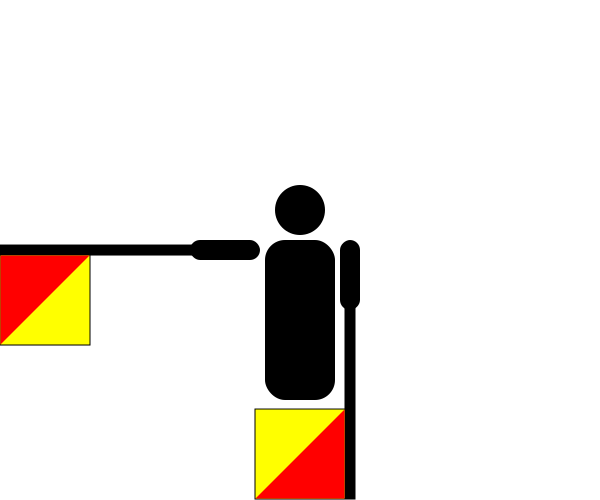


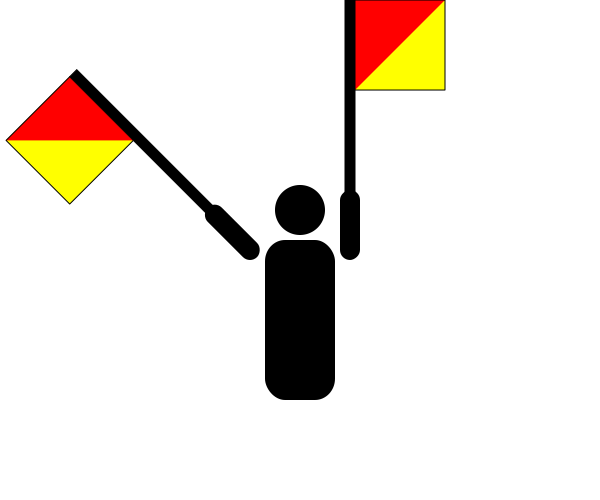

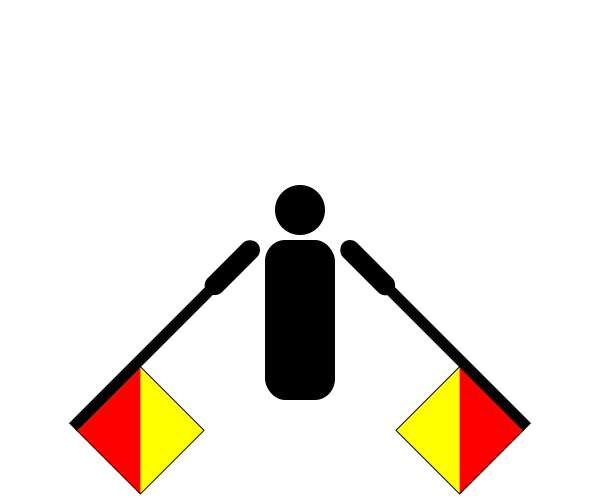
There are approximately 320 people named Basten in the UK. That makes it one of Britain's least common surnames. Only around five in a million people in Britain are named Basten.
Origin: English
Region of origin: British Isles
Country of origin: England
Religion of origin: Christian
Language of origin: English