BARTOS
Bartos is a surname with a history that traces back to several linguistic roots, including Aramaic, Czech and Polish. The name is a patronymic derivative, indicating descent from an ancestor bearing a related forename.
The earliest linguistic source is the Aramaic patronymic bar‑Talmāy, meaning “son of Talmāy”. The name Talmāy translates as “one with many furrows” and was historically associated with landownership and wealth. Through transmission into Greek and Latin, the form evolved into Bartholomeus, and later into the Polish and Czech given name Bartosz, a variant of Bartosz and ultimately the Polish form of Bartholomew.
In the Polish and Czech contexts, the surname Bartos is typically derived from the given name Bartosz, meaning “son of Bartosz”. The forename Bartosz itself is a diminutive of Bartłomiej, the Polish rendition of Bartholomew. Consequently, bearers of the surname can be understood as descendants of an ancestor named Bartosz or Bartłomiej.
Historical records from the late Middle Ages document the surname in a variety of spellings, including Bartos, Bartosz, Bartolomeu, Bartholomeus and Berthelemot. In 1199, a compilation of the Danelaw Charters of London contains the entry Bartholomeus Canonicus. Later, English records from 1296 list Nicholas Bertelmev of Sussex, while a 1334 London entry records Walter Berthelmeu. A German record from 1274 cites Wernus Bartholomei in Hamburg, and a 1624 inventory of Virginia mentions John Bate, a shortened form of the surname. The earliest known occurrence in the English county of Huntingdonshire is Robert Bartelmeu (1273), dated to the reign of King Edward the First (1272–1307). These early examples demonstrate the long-standing use of the name across medieval Britain, continental Europe and colonised America.
In addition to its Aramaic and Slavic origins, some sources note that the surname may also derive from Proto‑Germanic roots. In this theory, the stem bera means “to bear or carry” and the suffix -tuz carries a related sense. In certain areas, Bartos was adopted as a variant of Berthold, a Germanic name meaning “bright ruler”. Under this interpretation the name could also refer to a person “outside the borders”, perhaps an exile, or someone entrusted with a burden.
In Central and Eastern Europe, the surname is most frequently encountered in the Czech Republic, Slovakia and Hungary. According to 2020 statistics, Bartos ranks as the fourth most common surname in Hungary, appears in 3.7 of every million Slovakians, and is the 264th most common name in the Czech Republic. In Poland, a variation of the surname is Bartosz, and related derivatives such as Bartoszewski and Bartosik are also common. In the Czech and Slovak regions, Bartoš is a regular spelling, with further diminutives including Bartošek, Bartošová and Bartošova.
Across the global diaspora, the surname is represented in the United States, Canada, Australia, New Zealand and many European nations. Variants found abroad include Bartosz, Bartoš, Bartosek, Bartosiak, Bartoška, Bartošík, Bartošek, and Bartošíková.
In summary, the surname Bartos is a testament to a complex linguistic and cultural history that spans from ancient Aramaic roots through medieval Christian Europe to modern national identities across Central and Eastern Europe and beyond. Its multitude of spellings and adaptations reflects the diverse societies in which it has settled, while its patronymic structure underscores an enduring emphasis on lineage and ancestry.
Typical given names associated with the Bartos surname
Male
- Conrad
- David
- Gabor
- Hugh
- Martin
- Miroslav
- Paul
- Peter
- Richard
- Robert
- Stephen
- Thomas
- Tomasz
Female
- Anna
- Caroline
- Charlotte
- Clare
- Joanna
- Katarzyna
- Mandy
- Maria
- Natalja
- Patricia
Similar and related surnames
Related and similar names are generated algorithmically based on the spelling, and may not necessarily share an etymology.
How to communicate the surname Bartos in...
Braille
⠃⠁⠗⠞⠕⠎
Morse
-....-.-.----...
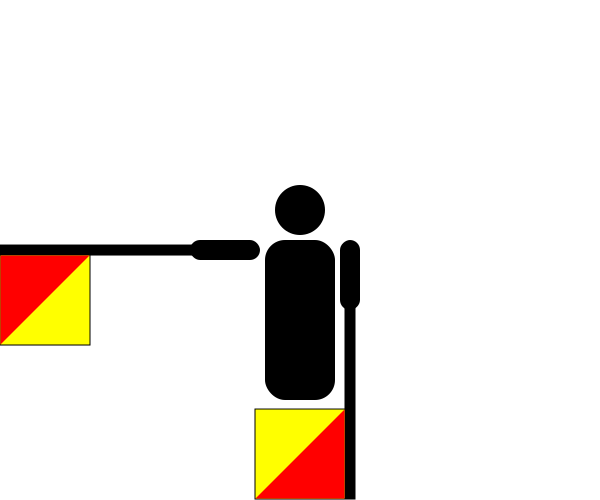
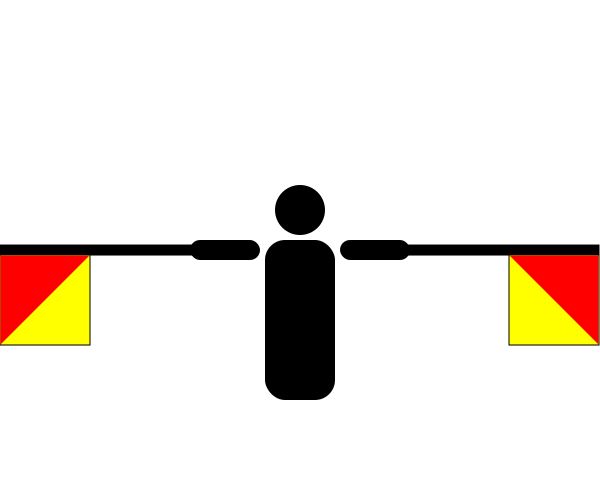
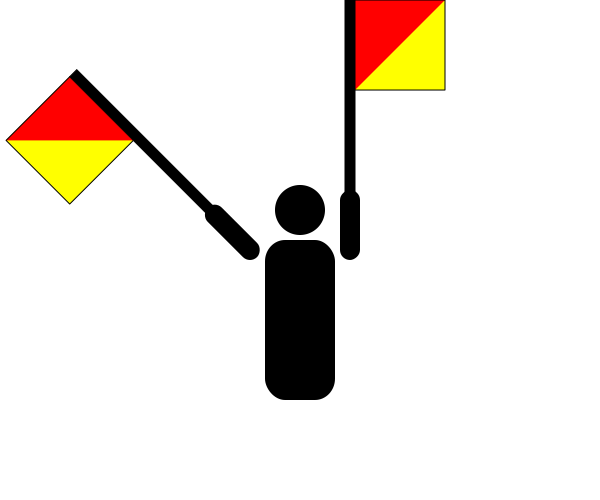
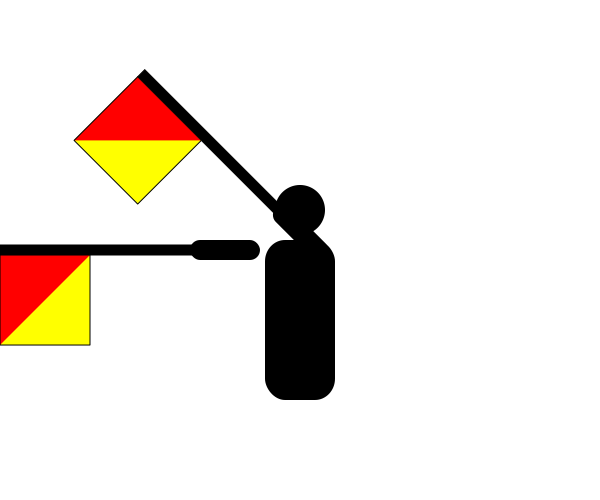
Semaphore


There are approximately 155 people named Bartos in the UK. That makes it one of Britain's least common surnames. Only around two in a million people in Britain are named Bartos.
