BANG
Bang is a surname that appears in several linguistic and cultural contexts across Asia and Europe, each with distinct etymological roots. In Korean usage it is derived from the Korean phoneme bang, which can signify room or house or, alternatively, help or assistance; the choice of meaning is historically contingent upon the individual family’s background and the circumstances of the name’s adoption. It is also understood to be an anglicised form of the Chinese surname Pang, which is written with characters meaning “fat” or “plump”. The Romanisation differences mean that the same Chinese cognate can appear as Bang or Pang in English records.
In the United Kingdom the name is found in medieval documents as a topographical designation. It was used for people dwelling on a slope or a riverside bank, derived from the Old English word banke and the Old Norse bakke. Early attestations include a Matthew Banke in the 1327 Suffolk Subsidy Rolls and a Nicholaus del Bancke in the 1379 Yorkshire Poll Tax, indicating that the name was recorded in its various spellings in the late thirteenth and early fourteenth centuries. Variants such as Banghe, Banger, Bankes and Banker persisted in the region, reflecting the fluid orthographic practices of the era.
Scandinavian origins trace the surname to the Old Norse bange meaning “dweller by the banks”. This is consistent with the name’s use among Danish and Norwegian families who lived near riverbanks or coastlines. An alternative Old Norse root, banga, meaning “to hammer” or “to pound”, associates the name with a blacksmith or a person known for loud noises. In both traditions the name could be extended into patronymic forms such as Bangsen (son of Bang) or diminutive variations like Bangesen. The Bang family crest, according to heraldic records, typically features a red shield with a silver wavy bend and three gold crowns, symbolising maritime connection and noble status.
Within Vietnam the surname appears in contemporary use, recorded in Vietnamese language sources. Although it is not traditionally of Vietnamese origin, the name has been adopted by Vietnamese families, often through colonial or international contact, and is written in Vietnamese orthography in accordance with local naming conventions.
Today, Bang remains a common surname in several nations. In Denmark and Norway it continues to be frequent, particularly in the south and along coastal settlements. In South Korea it is widely standardised as Bang, with alternative spellings such as Pang, Bahng or Bangs occurring in romanised documents. The name has also disseminated globally through migration; it is now present in the United States, where individuals with the surname Bang are found in diverse professional fields.
The contemporary visibility of the name is additionally amplified by the global influence of South Korean popular culture. Public figures such as Bang Si‑hyuk, founder of the music company Big Hit Entertainment, and Bang Chan, a member of the internationally acclaimed pop group Stray Kids, have contributed to international recognition of the name. Their prominence illustrates how a surname can cross cultural borders while retaining distinct historical roots.
Typical given names associated with the Bang surname
Male
- Chi
- Christopher
- Ho
- Imran
- Michael
- Paul
- Peter
- Robert
- Sai
- Thomas
Female
- Andrena
- Carolyn
- Diana
- Elizabeth
- Helen
- Kim
- Maria
- Ngoc
- Siew
- Signe
Similar and related surnames
Related and similar names are generated algorithmically based on the spelling, and may not necessarily share an etymology.
How to communicate the surname Bang in...
Braille
⠃⠁⠝⠛
Morse
-....--.--.
Semaphore
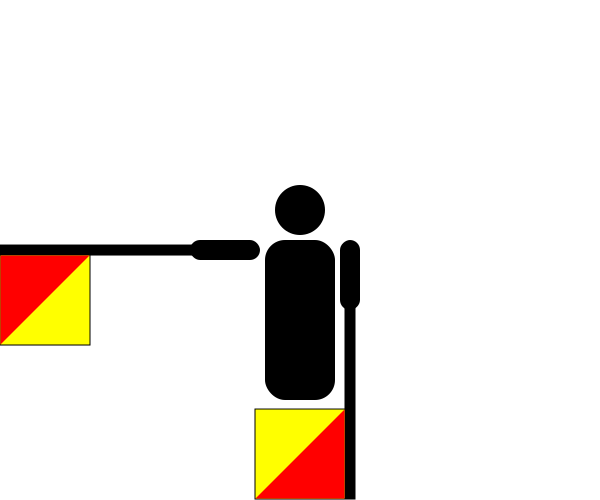

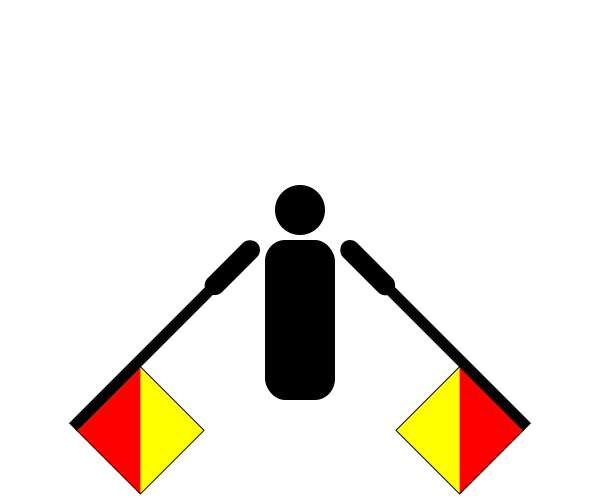

There are approximately 173 people named Bang in the UK. That makes it one of Britain's least common surnames. Only around three in a million people in Britain are named Bang.
Region of origin: Asia
Country of origin: Vietnam
Language of origin: Vietnamese
