BALMER
Balmer is a surname of complex provenance, reflecting the intertwined linguistic currents of the British Isles and continental Europe. Its earliest attestations appear in the records of England and Scotland in the late thirteenth century, where it is recorded as Banmere in 1305. Subsequent spellings, such as Balmar and Balmer, appear in parish registers from the fourteenth to the eighteenth centuries. The name is also found in a 1627 christening at St. Giles, Cripplegate, London, and later in 1753 in St. Martin in the Fields, Westminster, London. These references demonstrate the surname’s early stability in England and its spread through the English-speaking world.
The etymology of Balmer is contested. One tradition holds that the name is of Scottish Gaelic origin, derived from balbh, meaning “dumb” or “stammering.” This interpretation suggests that the name was originally a nickname given to an individual noted for a speech impediment or a reserved manner. An alternative theory links the surname to the Old French word basme or balme, meaning balm or ointment, and the agent suffix -er. Under this view, Balmer would denote a maker or seller of aromatic resins, oils, and medicinal preparations.
The occupational hypothesis is supported by Middle English usage, where the noun balme signified a balm‑maker. In medieval Europe, balm‑makers were highly regarded for producing ointments for medical and liturgical purposes. Successful artisans travelled markets and festivals, eventually settling in towns and families adopting the occupation as a hereditary surname. Consequently, the name spread from rural crafts to urban centres across England, Scotland, and, by the early modern period, to continental cities such as Newcastle, where a painter named George Balmer gained renown in the nineteenth century.
In Germanic‑speaking regions, the surname and its variants are common, particularly in Switzerland, Germany, Austria, and Liechtenstein. The name has also been recorded in Alsace and Saxon parts of Germany and is represented in the United States, especially in Pennsylvania, Virginia, and North Carolina. Though the name is contemporary in South America—primarily in Chile and southern Brazil—its presence in Asian countries such as Japan, South Korea, and India is sparse. In the British Isles, Balmer remains a comparatively uncommon surname, yet it has persisted in both rural and urban communities.
Variations of the surname illustrate linguistic adaptation across regions. Common forms include Balmar, Belmer, Boelmer, Bollmer, Ballmann, Baumli, and Beall. Adaptations reflecting anglicisation appear as Bolam, Boolam, Bolem, Beal, and Bealmey, while Germanic variants such as Bollermann, Boelman, and Baalman are widespread in Germany and Austria. In Scotland and Ireland, derivations such as Baillee, Bell, and Bayly hint at the surname’s integration into Celtic naming practices. These diverse spellings underscore the mobility of the name and its capacity to assimilate into differing phonological systems.
Historical records indicate that the identity of the Balmer name evolved from an occupational descriptor to a family surname over several generations. The original “balm‑maker” or “dumb” nickname ceased to reflect a literal occupation or characteristic, taking on a purely genealogical function. This transition mirrors broader patterns within British surnames, where many occupational names such as Smith, Baker, and Fisher became hereditary family markers in the Middle Ages.
Despite its varied origins, the surname Balmer has maintained a consistent presence within the historical record of the British Isles while also achieving a notable diaspora. Its persistence in contemporary genealogical research reflects both its antiquity and its adaptability across linguistic and cultural boundaries. The surname thus offers insight into medieval occupational practices, the spread of Gaelic and French linguistic influences, and the migratory trends that shaped pluralist societies in Britain and beyond.
Typical given names associated with the Balmer surname
Male
- Alan
- Andrew
- David
- James
- John
- Michael
- Paul
- Robert
- Stephen
- Thomas
- William
Female
- Anne
- Claire
- Elizabeth
- Helen
- Jacqueline
- Jean
- Joanne
- Karen
- Margaret
- Mary
- Sarah
- Susan
Similar and related surnames
Related and similar names are generated algorithmically based on the spelling, and may not necessarily share an etymology.
How to communicate the surname Balmer in...
Braille
⠃⠁⠇⠍⠑⠗
Morse
-....-.-..--..-.
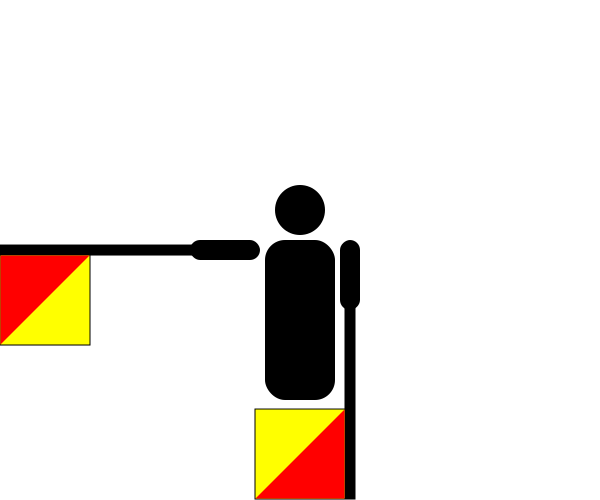
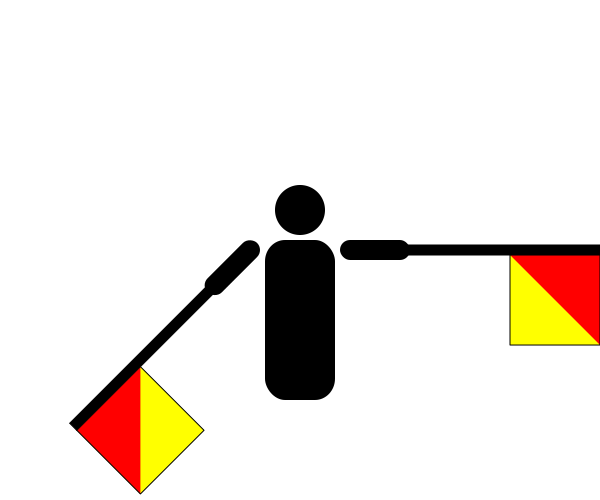
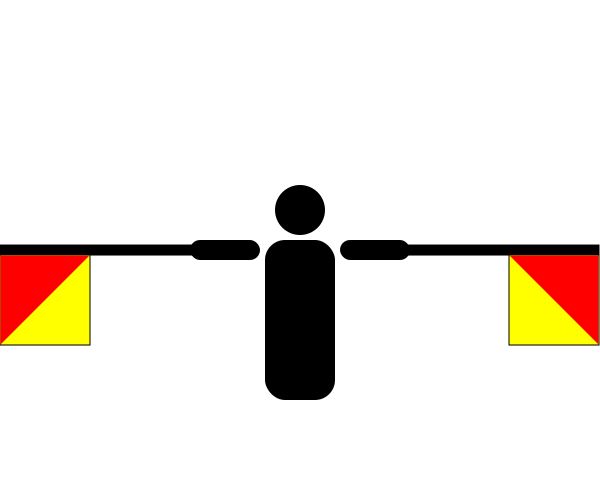
Semaphore



Did you know?
According to a survey carried out by Democracy Club, politicians and candidates with the surname Balmer are most likely to say that their favourite biscuit is a Chocolate Chip Cookie.
There are approximately 2,778 people named Balmer in the UK. That makes it roughly the 3,219th most common surname in Britain. Around 43 in a million people in Britain are named Balmer.
Surname type: Occupational name
Origin: English
Region of origin: British Isles
Country of origin: England
Religion of origin: Christian
Language of origin: English

Famous people named Balmer
- Stuart Balmer - Scottish football player
- Billy Balmer - Football player (1877 to 1937)
- Bob Balmer - Football player
Names and descriptions courtesy of Wikipedia, and may contain errors. This is not intended to be an exhaustive list of every famous person with this name.