BADGER
Badger is an English surname that arose in the Middle Ages largely as an occupational name. Its earliest uses denote a person involved in the hunting or trapping of the native mammal, or alternatively a maker or seller of bags, both professions that were common in rural and market communities across the British Isles.
The name is derived from the Middle English word badger, which in that period meant a person who hunted or trapped the animal of the same name. It is also linked to the Middle English term baggere, itself a derivative of the Old English bagge, meaning a bag. Consequently, The surname could have signalled a craftsman who produced sacks, or a peddler who supplied provisions such as corn and grain, roles that were highly valued in medieval commerce.
Early records illustrate several spellings that have persisted into the modern era. For instance, Ivo le Bagger appears in the Assize rolls of Lancashire in 1246, while Adam Badger is found in the 1324 register of the Manor of Wakefield, Yorkshire, and Ralph Baghere is recorded in Derbyshire in 1348. These variations—Badger, Bagger, Badgers, Baghere—show how regional dialects and phonetic shifts influenced the family name over the centuries.
Geographically, the surname was predominantly concentrated in eastern England, with notable concentrations in Kent and the West Midlands. Census and genealogical data indicate that Badger sufferers remain common in England to this day, and the name has also spread to former British colonies. It is found in significant numbers in the United States—particularly in Wisconsin, New Hampshire and Maine—as well as in Canada’s Ontario province and Australia.
The occupational dimension of the name is further supported by the medieval term badger as a trade designation. A “badger” was a provincial dealer, often a middleman between farmers and market stalls, who transported foodstuffs such as corn. This commercial activity dovetailed neatly with the bag‑making or peddling interpretation, and the title eventually became a hereditary surname for many families involved in such enterprises.
While the precise origin of the surname can vary among individuals—some families trace their lineage to the animal‑hunter interpretation and others to the bag‑maker or trader—what is clear is that Badger is a surname rooted deeply in the social and economic fabric of medieval England. Its endurance and geographic spread attest to the lasting impact of these early occupations on contemporary family lineages.
Typical given names associated with the Badger surname
Male
- Andrew
- David
- John
- Mark
- Michael
- Paul
- Peter
- Philip
- Richard
- Robert
- Stephen
Female
- Caroline
- Christine
- Claire
- Emma
- Janet
- Joan
- Karen
- Lisa
- Margaret
- Mary
- Sarah
- Susan
Similar and related surnames
Related and similar names are generated algorithmically based on the spelling, and may not necessarily share an etymology.
How to communicate the surname Badger in...
Braille
⠃⠁⠙⠛⠑⠗
Morse
-....--..--...-.
Semaphore
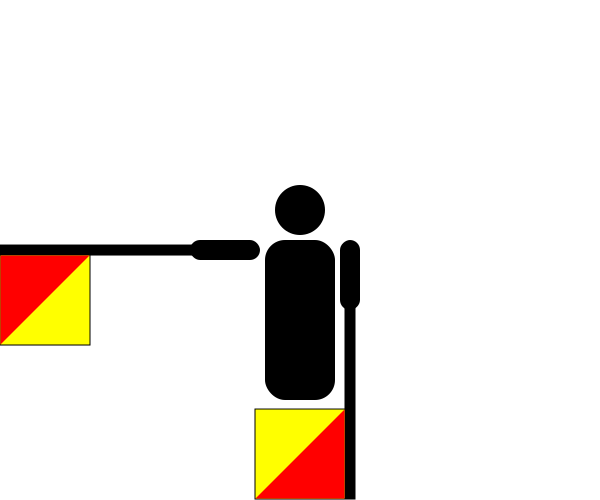


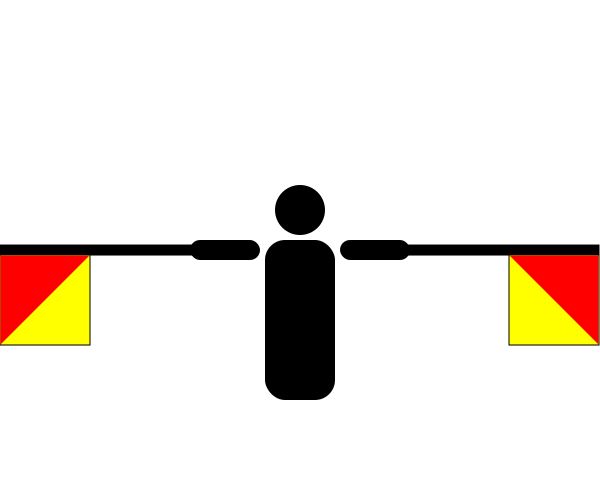
There are approximately 3,215 people named Badger in the UK. That makes it roughly the 2,822nd most common surname in Britain. Around 49 in a million people in Britain are named Badger.
Surname type: Occupational name
Origin: English
Region of origin: British Isles
Country of origin: England
Religion of origin: Christian
Language of origin: English

Famous people named Badger
- Tony Badger - Historian
- Mike Badger - Musician
- Len Badger - Football player
- Owen Badger - Welsh rugby union and rugby league football player (1871 to 1939)
- Bert Badger - Football player (1882 to 1965)
- Henry Badger - County cricketer (1900 to 1975)
Names and descriptions courtesy of Wikipedia, and may contain errors. This is not intended to be an exhaustive list of every famous person with this name.