AYUB
Origins
The surname Ayub derives from Arabic linguistic roots and is traditionally associated with the Islamic prophet Job, whose name is rendered Ayyub in Arabic. The name has been transmitted through Arab and South‑Asian cultures, particularly among Muslim communities in the Middle East and the Indian sub‑continent.
Etymology and Meaning
The Arabic term Ayub identically corresponds to the Biblical figure Job, a model of steadfast faith and endurance. In Islamic tradition Ayub is esteemed for patience and moral resilience, qualities that the surname implicitly honours. A literal translation of the word is “one who returns from long weariness”, emphasising the notion of triumph over hardship.
Geographical Distribution
According to reputable surname databases, Ayub is most frequently found in Pakistan, India, Afghanistan, Turkey and Saudi Arabia. Within the Indian sub‑continent it is common in Kashmir, Sindh, Gujarat and Bangladeshi Muslim households. The diaspora community also carries the name in the United Kingdom, the United States and Canada, albeit at a lower frequency.
Spelling Variants
Variations of the surname reflecting regional languages and orthographic preferences include Ayoub, Ayyub, Ayoob, Aiyub and Ayoube. In North Africa, Ayoubi and Ayoube are common. South‑Asian variants such as Ayyub and Ayoobiy are observed particularly among Gujarati Muslim communities. In South‑Africa, the prefix Aya is sometimes combined with the surname, yielding forms like Ayaub. In Sri Lanka, Aathi Ayub is recognised within the Tamil Muslim community.
Cultural Significance
In Muslim societies the surname is regarded as an honourific, signifying respect for a family’s perseverance and service. It is employed in formal address, occasionally prefacing the given name (for example, Ayub Abdullah) or following it as an inherited surname. Individuals bearing Ayub typically occupy roles such as business leaders, clerics, or civil servants, thereby reinforcing its association with influential community positions.
Notable Bearers
The most prominent historical figure with this surname is General Ayub Khan, who ruled Pakistan from 1958 to 1969. His leadership is frequently cited as an illustration of the strength and determination that the name embodies. Other contemporary figures include scholars, activists and artists who carry the surname across various professional fields.
Modern Usage
Today, the name continues to be held in esteem and is used in formal contexts such as legal documents, academic citations and official correspondence. While the prevalence of the surname has modestly declined in non‑Islamic majority countries, it retains significance within Muslim communities worldwide.
Typical given names associated with the Ayub surname
Male
- Ali
- Asif
- Ebrahim
- Faisal
- Imran
- Mohammad
- Mohammed
- Muhammad
- Nadeem
- Qaisar
- Raja
- Tahir
- Yousef
Female
- Farhat
- Nazia
- Parveen
- Razia
- Sadia
- Saima
- Shabana
- Shazia
- Sofia
- Tahira
Similar and related surnames
Related and similar names are generated algorithmically based on the spelling, and may not necessarily share an etymology.
How to communicate the surname Ayub in...
Braille
⠁⠽⠥⠃
Morse
.--.--..--...
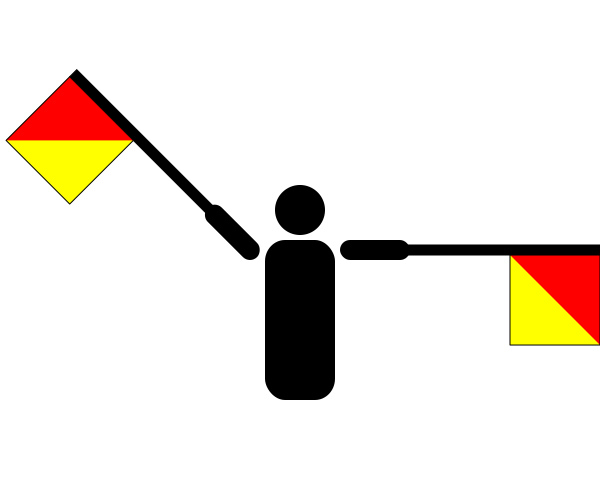
Semaphore



There are approximately 2,833 people named Ayub in the UK. That makes it roughly the 3,150th most common surname in Britain. Around 44 in a million people in Britain are named Ayub.
