AYLETT
The surname Aylett is of English origin, first recorded in the late medieval period.
Its etymology is most commonly linked to the medieval given name Ailard or Ailward, which itself is a composite of the Old English elements ail, meaning “noble”, and ward, meaning “guardian” or “protector”. As a family name, it would therefore signify a descendant or someone connected with an ancestor bearing that personal name, implying noble or guardian‑like qualities.
This surname also appears in the Domesday Book of 1086 under the forms Ailiet and Aliet, derived from earlier pre‑7th‑century Old English names such as Aeoelgyo and Aeoelgeat. These break down into aoel (noble) with gyo (battle) or gait (great), thereby giving the sense of a “noble combatant” or a “noble great”. Variants such as Elget and Eliet can be traced back to the same linguistic roots and have fed into the modern spellings of Elliot and its relatives.
The earliest recorded spelling of the family name is found in the Hundred Roll of Cambridgeshire in 1279, where a person named Boydin Ailot is documented. Subsequent nineteenth‑century records show a range of spellings including Aylott, Allatt, Allett, Allitt, Alliott, Ellyatt, Eliott and Elitt—each reflecting local pronunciation and orthographic practice.
Another scholarly hypothesis, relying on Old French influence, proposes that the name derives from the Old French personal name Ailet, a diminutive of Ail meaning “garlic”. The suffix -ett in French denotes smallness or affection, so that Aylett could originally have been a nickname or term of endearment. This theory also acknowledges a possible link with the Old High German element Athal, again denoting nobility. However, the existence of multiple derivations underscores the cultural and regional fluidity of surname evolution in medieval England.
Further etymological analysis identifies Aylett as a variant of the Old English personal name Aethelgeat (sometimes rendered Ealhhere), composed of ael (noble) and geat (warrior). In this construction the suffix -ett acts as a diminutive or patronymic marker, suggesting the meaning “descendant of the noble warrior”.
Geographically, the surname remains most densely populated in England, particularly within Norfolk, Hertfordshire, Gloucestershire and Kent, where its earliest early‑modern appearances were concentrated. In the United States the name is more sparsely distributed, appearing in various states without a single dominant concentration, a pattern reflecting early migration from the British Isles. Occasional instances are also recorded in Canada, Australia and other former British colonies.
Documented individuals bearing the surname include Alice Aylett, christened on 20 July 1648 at St. Peter's, Pauls Wharf, London, and Walter Ellit, who departed for St. Christopher in the West Indies on 15 October 1635. Such entries illustrate the surname’s long‑standing presence across a range of social contexts in the English world.
Today, people with the surname Aylett can be found in various parts of the world, though the name remains relatively uncommon. Its linguistic heritage, spanning Old English, Anglo‑Saxon and Old French influences, provides a concise illustration of how personal names of noble or protective character can evolve into family names through centuries of linguistic change and migration.
Typical given names associated with the Aylett surname
Male
- Christopher
- Darren
- David
- Edward
- Ian
- James
- John
- Mark
- Martin
- Michael
- Paul
- Peter
- Simon
- Stephen
Female
- Angela
- Elizabeth
- Emily
- Emma
- Helen
- Linda
- Lisa
- Margaret
- Rebecca
- Sarah
Similar and related surnames
Related and similar names are generated algorithmically based on the spelling, and may not necessarily share an etymology.
How to communicate the surname Aylett in...
Braille
⠁⠽⠇⠑⠞⠞
Morse
.--.--.-...--
Semaphore

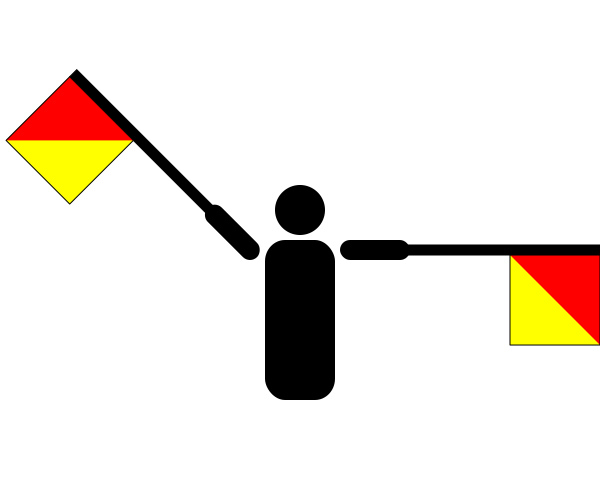


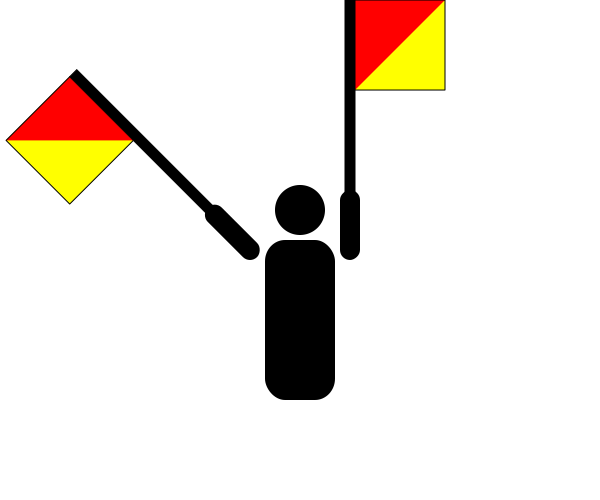
There are approximately 1,157 people named Aylett in the UK. That makes it roughly the 6,598th most common surname in Britain. Around 18 in a million people in Britain are named Aylett.
