AUSTON
Auston is an English surname of Anglo‑Saxon provenance, with several scholarly hypotheses concerning its precise origin. In the majority of cases the name is understood to have evolved either from the Old English personal name Æðelstan, which literally means “noble stone”, or from a locational descriptor referring to an eastern settlement, derived from the Old English words east and tun meaning “town” or “enclosure”.
In the earliest surviving documents the surname appears as Henry Austin in the County Pipe Rolls of Worcestershire dated 1275, during the reign of King Edward the First (1272–1307). This record provides the first verifiable instance of the name in its patronymic form, identifying the descendant of a man named Austin or Austin‑derived.
During the 12th and 13th centuries the name re‑emerged in connection with the religious order of the Austin Canons, a Christian community dedicated to the saint that later became known as Saint Augustine of Canterbury. As members of this order, who were celibate and served on various properties, were occasionally identified by association with their houses, the surname accrued a baptismal dimension and spread across the British Isles. The connection with the saint was further cemented when the Austins of Surrey were granted a coat of arms in 1611 – a silver shield bearing three black chevrons, the centre point charged with three gold crosses.
The spelling of the surname varies widely, producing forms such as Austin, Austen, Aston and Astin. These variants are largely orthographic reflections of regional pronunciation or the transcribing scribe’s preference, rather than distinct lineages. In contemporary usage the form Auston remains comparatively uncommon, though it is represented among families now dispersed throughout the United States, Canada and Australia.
The migration of bearers of the surname to the New World is attested by the passenger lists of early colonial ships. A notable example is Edward Austin, aged 26, who sailed from London aboard the Speedwell in May 1625 and settled in the early English colonies. The name also appears in records of the 17th‑century political conflicts; for instance, Thomas Austin of Somerset was condemned by Judge Jeffreys in 1685, orders stemming from the Monmouth Rebellion, and was subsequently transported to a plantation in the West Indies.
In modern times the surname is also associated with individuals of note, such as the Canadian ice‑hockey player Auston Matthews, whose reputation has contributed to a modest increase in the surname’s visibility. Nevertheless, demographic surveys indicate that the name remains rare on a global scale, with the majority of recorded instances located in the United States, particularly in the southern states of Texas, California, New York, Florida and Georgia, and in Canada.
The persistent use of the forms Auston and its variants underscores the dynamic nature of surname evolution, reflecting linguistic shifts, religious influences, and migratory movements that have shaped English naming practices over the centuries.
Typical given names associated with the Auston surname
Male
Female
Similar and related surnames
Related and similar names are generated algorithmically based on the spelling, and may not necessarily share an etymology.
How to communicate the surname Auston in...
Braille
⠁⠥⠎⠞⠕⠝
Morse
.-..-...-----.
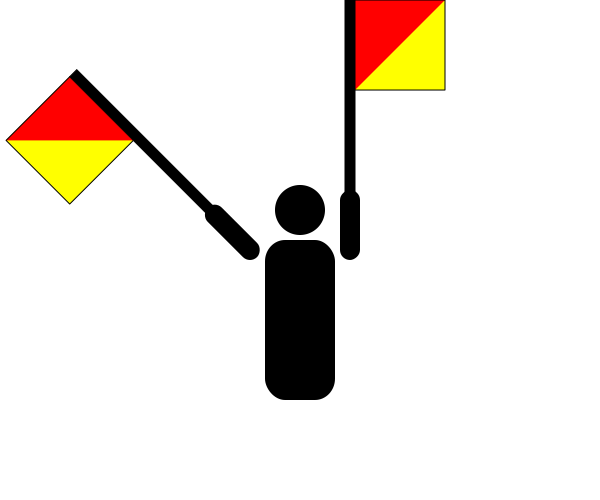
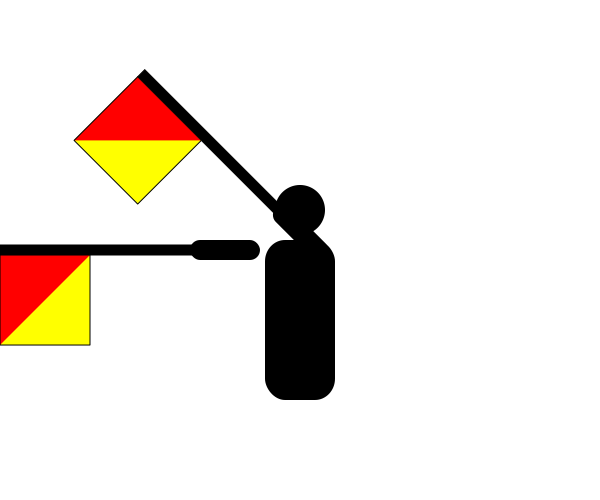
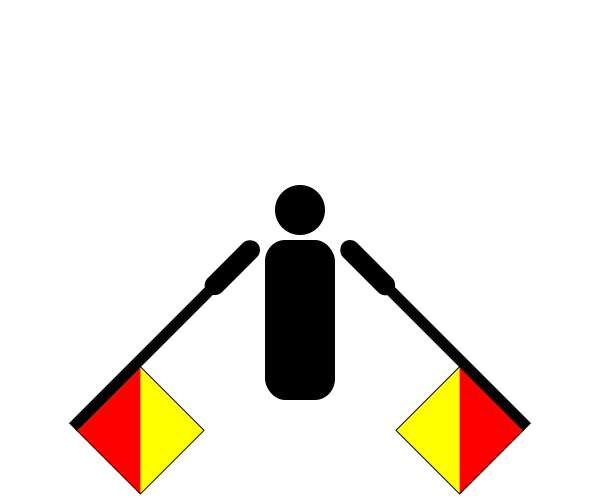
Semaphore


There are approximately 106 people named Auston in the UK. That makes it one of Britain's least common surnames. Only around two in a million people in Britain are named Auston.
