ARMISTEAD
The surname Armistead is an English name that has its origins in the British Isles. It is chiefly found in the northern counties of England and is classified as a topographical or habitation surname, deriving from a specific place or natural feature.
Historical linguistics attribute the formation of Armistead to Old English and Middle English roots. In one tradition, the name is said to arise from the personal name Ermest, meaning “whole” or “universal”, combined with the word stede meaning “place”. The composite thus yields the sense “dweller at the place of Ermest” or “one who comes from Ermest’s place”. Another well‑documented derivation sees the surname evolve from the Middle English word hermite (hermit) and stede. In Yorkshire, the local pronunciation of hermite was armit, giving rise to early spellings such as Johannes de Armetstede in 1379. This onomastic development produced the modern variants Armitstead, Armistead and Armstead.
Records from Yorkshire Church Registers confirm the use of the name in the sixteenth and early seventeenth centuries. Notable entries include the christening of Agnes, daughter of John Armistead, at Horton in Ribblesdale on 27 January 1559; the marriage of Janet Armistead to William Heaton at Giggleswick on 14 July 1560; and the christening of Elizabeth, daughter of Edward Armstead, at Wetherby on 5 April 1622. These documents illustrate the surname’s deep entrenchment within local communities of medieval Yorkshire.
The surname also appears in the annals of Irish history. In the mid‑seventeenth century it can be found in the counties of Louth and Cork, where it subsequently became established in north Tipperary and Offaly. The earliest surviving record of the family name in England is carried by Laurencius del Armetsted, dated 1379 in the “Poll Tax Returns Records of Yorkshire”, during the reign of King Richard I, known as “Richard of Bordeaux”.
An older hypothesis links Armistead to Old Norse terminology, specifically the term hermðar‑staðir, describing a hermit’s dwelling or a lonely house. The Old Norse phrase eventually evolved into Ermysted and then into the English Armistead. The first documented instance under this form appears in the fourteenth century as William de Ermysted of Yorkshire. The surname’s Norse background also explains its occasional association with Viking settlements in Lancashire.
Over the centuries the name has been preserved in several variant spellings: Armstead, Armitstead, Armisted, and occasionally Armstead. These variations express the same essential meaning but reflect regional accents and transcription practices. In present times, Armistead remains a recognised surname in the United Kingdom, particularly in areas near its place of origin, and within English‑speaking communities worldwide, notably in the United States. In American history the name is most famously linked to Major Louis Armistead, a Civil War officer remembered for his valour during the Battle of Gettysburg.
Thus, the Armistead surname encapsulates a rich linguistic heritage that spans Old English, Middle English, Old Norse and French influences, while providing a direct link to a specific geographical location and the people who once inhabited it.
Typical given names associated with the Armistead surname
Male
- Alan
- Andrew
- Daniel
- David
- John
- Mark
- Matthew
- Michael
- Paul
- Peter
- Stephen
Female
- Barbara
- Christine
- Claire
- Doris
- Emma
- Gloria
- Jacqueline
- Linda
- Louise
- Lynne
- Margaret
- Mary
- Sarah
- Susan
Similar and related surnames
Related and similar names are generated algorithmically based on the spelling, and may not necessarily share an etymology.
How to communicate the surname Armistead in...
Braille
⠁⠗⠍⠊⠎⠞⠑⠁⠙
Morse
.-.-.--.....-..--..
Semaphore

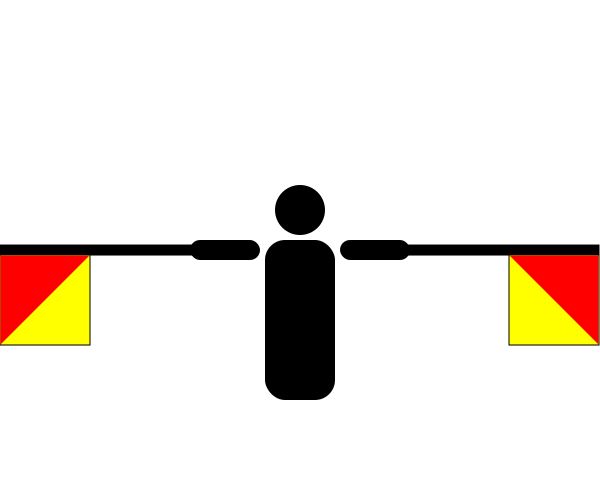



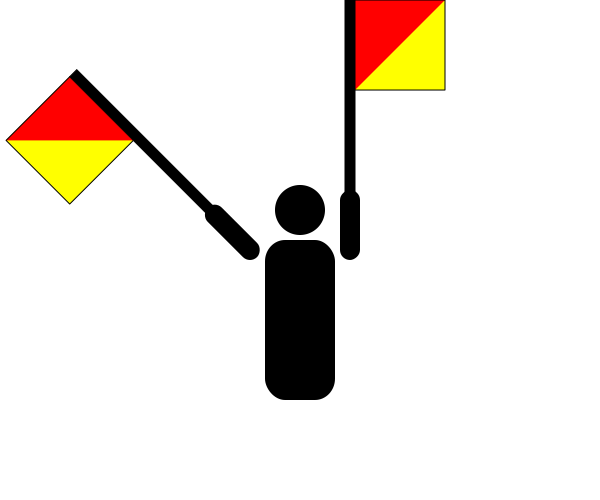


There are approximately 641 people named Armistead in the UK. That makes it one of Britain's least common surnames. Only around ten in a million people in Britain are named Armistead.
Surname type: Location or geographical feature
Origin: English
Region of origin: British Isles
Country of origin: England
Religion of origin: Christian
Language of origin: English
