ARGUE
In the history of surnames, Argue is a relatively uncommon Gentile, yet one with a distinctly colourful provenance that reflects the intermingling of Celtic, Anglo‑Saxon and continental European influences across the British Isles.
The earliest documented roots of the name are Gaelic and Scottish. The Gaelic word *argadh* meaning “silver’’ has been cited as the source of the original nickname. According to the records, the name was attributed to an individual who possessed silver‑tinged hair or, alternatively, who worked professionally with silver, an occupation that would have earned a distinctive moniker in a small community.
Over centuries, the variant Argue migrated from a descriptive epithet into a hereditary surname, a process that is reflected in medieval documentation from the northern half of England and the western reaches of Scotland. The name appears in a range of spellings that have persisted to the present day: Argen, Argon, Argent, Argo, Argoe, Hargy, Hargerie. The patronymic forms have not survived widely, but the spellings listed above are all recorded in deeds and tax rolls from the thirteenth and fourteenth centuries.
Some early occurrences show a geographical rather than an occupational connection. For instance, a man named John Largent is recorded in the Suffolk Hearth Tax rolls of 1524, a document that also lists a Aaron Argoe christened in London in 1605. William Argent of St Margarets, Westminster appears on a parish register in 1686, while Maria Hargie is noted in Stepney in the mid‑nineteenth century, the surname in that case having been altered to Harrgie.
Further noteworthy entries include the presence of a Robert Hargerie of York, who married Elizabeth Auston during the siege of York in 1644. The surname also has a recorded appearance in Irish civil registers; a David Argue is documented at Dromore, County Down, in 1795, with a subsequent entry for Catherine Argo in the same locality in 1821.
The medieval period also provides evidence of a family name that dates back to the reign of King Henry XI (1154‑1189). One of the earliest attestations is that of Geoffrey Argent in the 1180 pipe rolls of Northamptonshire, a now‑ancient record that illuminates the earliest official use of a related form of the name.
In more recent times, the surname has remained geographically dispersed but at relatively low frequencies. It is most widely found in the United Kingdom, with concentrations in Scotland’s Aberdeen and Ayrshire counties, Scotland’s census records listing over five hundred individuals bearing the name. In Ireland, the apple of the name is located mainly in counties Donegal, Cork, Dublin and Louth where it appears in official documentation for more than seven hundred people.
Elsewhere in the modern world, the name has a modest yet clear presence. Within the United States, more than eight thousand individuals carry the surname, making it relatively common there. In Australia, the name is most frequently recorded in Victoria, New South Wales and Queensland, with a total of over a thousand officeholders in census data. The colonies of South Africa also contain some clusters in Cape Town, Durban and Johannesburg, totalling roughly five hundred bearers.
Variations of the name arise naturally from linguistic shifts over the centuries. Apart from the spellings already mentioned, the name has also been seen as Argyle, Argall, Argal, Argile, Arjill and Argyll and the occasional typographical forms that appear in public record, such as Arguello or Argueell when the name migrated to the colonies.
The etymological interpretation of Argue remaining as “silver’’ lends itself well to the historical practise of nicknames identifying individuals by distinctive physical attributes or trade. Nonetheless, the surname also has alternate, non‑alleged meanings—as noted in various specialist sources citing French, Germanic, Basque and even Latin origins—once again underlining the complex layers of surname heritage. Yet, these alternate origins do not supersede the documented evidence of the Gaelic and medieval English lines that underpin the historical record of Argue.
In sum, the surname Argue is a family name that has travelled from the early Gaelic linguistic environment of Scotland to the diverse cultural tapestries of the modern world, sustaining itself through variations that echo its linguistic journey while retaining a core identity tied to its original meaning of “silver’’ or “silver‑haired’’. Its lasting presence in contemporary record demonstrates the resilience of a surname that has evolved from a simple nickname into a marker of lineage and heritage across continents.
Typical given names associated with the Argue surname
Male
- Alan
- Bruce
- Colin
- Derry
- James
- John
- Joseph
- Michael
- Peter
- Sean
- Stuart
- William
Female
- Caroline
- Claire
- Joan
- Joanne
- Kezia
- Margaret
- Mary
- Michelle
- Pauline
- Sarah
Similar and related surnames
Related and similar names are generated algorithmically based on the spelling, and may not necessarily share an etymology.
How to communicate the surname Argue in...
Braille
⠁⠗⠛⠥⠑
Morse
.-.-.--...-.
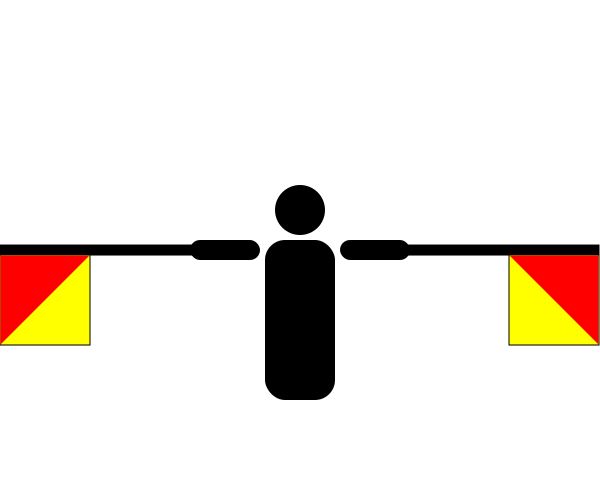
Semaphore



There are approximately 144 people named Argue in the UK. That makes it one of Britain's least common surnames. Only around two in a million people in Britain are named Argue.

Famous people named Argue
- Jimmy Argue - Scottish football player (1911 to 1978)
Names and descriptions courtesy of Wikipedia, and may contain errors. This is not intended to be an exhaustive list of every famous person with this name.