ANKER
Origin and etymology of the surname Anker have been traced to both Germanic and Dutch roots. The name derives from the Middle High German word anker, translated as "anchor", and in Old Dutch from a similar source. The term was used to describe items of maritime equipment and, by extension, to denote the profession of an anchor maker or a sailor.
In the early medieval period, the name entered England with the Norman conquest. It appeared in its Old French form Arichier, a personal name or nickname meaning "the anker"—an anchorite or hermit—therefore suggesting an association with solitude or religious devotion. The earliest English record is found in the Northamptonshire Curia Rolls of 1208, where an individual appears as Anker de Fressenvill.
From that point the surname acquired a variety of spellings, including Anker, Ankers, Anchor, Annacker, and Annercaw. Church registers in London document the use of the name in marriages: for instance, Jhon Ankars wed Agnes Dixson on 26 January 1538 at St. Stephen, Coleman Street, and Mary, daughter of Willi Ankers, was christened on 26 August 1660 at St. Olave's, Southwark. A separate record lists a John Ankers marrying Mary Perriman on 9 November 1698 at All Hallows, London Wall.
Historical documents also indicate the name's early presence in Nottingham. An instance of the spelling Alice Anker is dated to 1395 and appears in the Records of the Borough of Nottingham, during the reign of King Richard the Lionheart. Such records show that the family name was established well before the 16th century.
Across continental Europe, the surname is predominantly found among German‑speaking populations in Germany, Austria, Switzerland and the Netherlands, as well as in parts of Belgium, Luxembourg, Sweden, Finland and Denmark. In the latter countries it often appears as Ancker or Ankerman. The name also migrated to the United States during the late 18th and early 19th centuries, when German and Scandinavian emigrants settled in the Midwestern and Northeastern regions. Census data indicate that Anker remains ranked among the top fifteen thousand surnames in the country.
The appellation carries connotations of stability, reliability and strength, all attributes associated with an anchor—a device used to keep ships in place and to protect them from instability. As a surname, Anker therefore conveys a symbolic connection between individuals, families and communities, suggesting steadfastness even amid turbulent circumstances.
Numerous spellings exist, reflecting linguistic variations across Europe. Some of the recorded variants include Anckar, Ankor, Ancise, Anchour, Angor, Ankie and Anken. In Italy the variant Ancona is common, while in Spain it appears as Ancrom. These spellings all stem from the same Germanic root meaning "anchor" or "to anchor".
Consequent evidence from church registers, civil documents and census records confirms that the surname Anker has a long-standing presence in England and beyond. It retains a clear occupational origin while also embodying the virtues of steadfastness and secure connection that have endured through centuries of migration and cultural change.
Typical given names associated with the Anker surname
Male
- Anthony
- Brian
- David
- James
- John
- Mark
- Michael
- Oren
- Raymond
- Robert
- William
Female
- Ann
- Claire
- Deborah
- Dorothy
- Helen
- Janet
- Jean
- Julia
- Julie
- Karen
- Lesley
- Nicola
- Sarah
- Susan
- Victoria
Similar and related surnames
Related and similar names are generated algorithmically based on the spelling, and may not necessarily share an etymology.
How to communicate the surname Anker in...
Braille
⠁⠝⠅⠑⠗
Morse
.--.-.-..-.
Semaphore

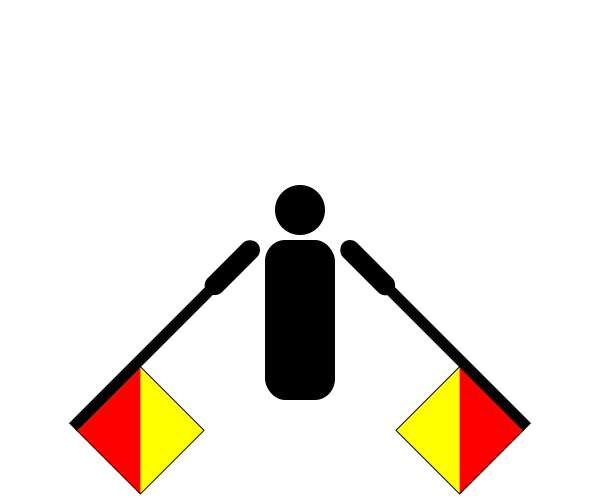
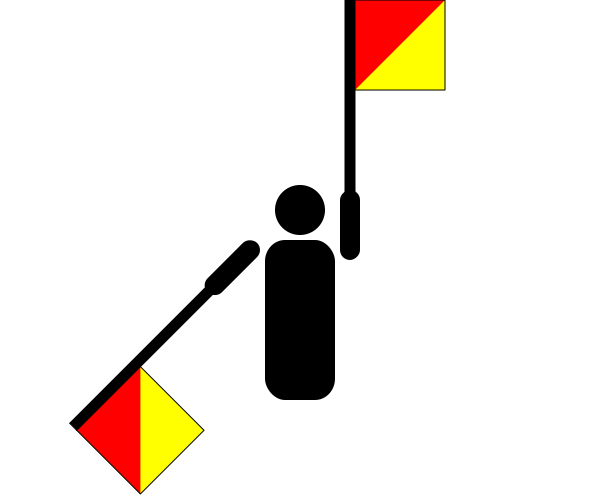

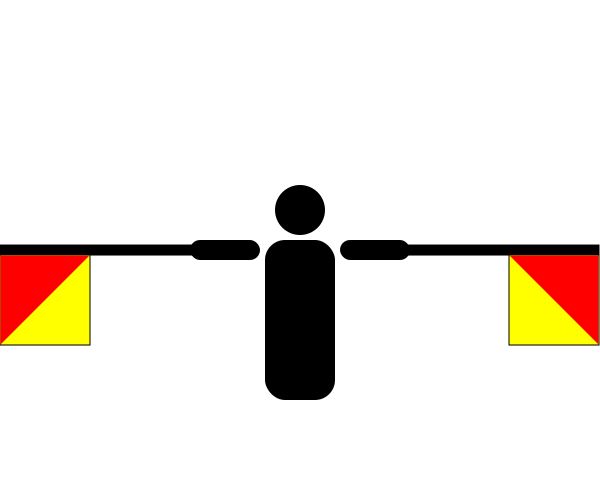
There are approximately 545 people named Anker in the UK. That makes it one of Britain's least common surnames. Only around eight in a million people in Britain are named Anker.
Surname type: Occupational name
Origin: English
Region of origin: British Isles
Country of origin: England
Religion of origin: Christian
Language of origin: English
