ANGLIN
Anglin is a surname that is found throughout the British Isles and in many English‑speaking countries, with a pronounced presence in Ireland, particularly in County Cork. The name has origins in both Gaelic and Anglo‑Saxon traditions, which explains the diversity of its spelling forms and the popularity it has achieved in different regions.
The Gaelic origin of Anglin is usually acknowledged as deriving from the patronymic Ó hAinleáin, meaning “descendant of Ainleán.” The personal name Ainleán is itself formed from the word ainle, which translates as “beauty” or “grace.” This interpretation is supported by historical records that locate families bearing the name primarily in County Cork, where the prefix Ó indicates a male line of descent.
Another lineage of the surname appears in the Gaelic form O’hAngluinn, which translates roughly as “male descendant of Anglunn.” The by‑name Anglunn is thought to be derived from anglonn, meaning “champion.” The first documented use of this form dates back to the late fifteenth century, with the name Fionn O’hAnghluinn recorded in the Annals of the Four Masters in 1490. Early Anglicised variants in the Elizabethan registries include O’Hanglen, Anglyn, Angiant, Angyllant and Anglound.
In a separate Gaelic tradition, the word Angallán has been suggested as the root of the surname, meaning “fierce courage” or “extraordinarily brave.” Families who carried this form also settled in the province of Munster, and the association with bravery has occasionally been quoted in historical accounts of the Anglin people.
From an Anglo‑Saxon perspective, Anglin is recorded as meaning “Englishman.” The name seems to have arrived in Britain after the Norman conquest of 1066, with the earliest documented instance appearing in Suffolk in the early 1200s. Variants such as Angliss, Angless and Anglais are frequently found in medieval English Latin and Norman French manuscripts.
The surname is most common in Ireland and the United Kingdom today, but it also appears in the United States—particularly in Mississippi—Canada, Australia and New Zealand. The concentration in these countries is largely a result of Irish and British emigration during the nineteenth and early twentieth centuries. In the United States, the name was notably associated with the narrative of the Anglin brothers, who gained notoriety as escapees from Alcatraz in the 1960s.
Because of the influence of English standardisation and the process of Anglicisation, the surname has acquired a wide range of spellings. Besides the most frequent forms Anglin and O’Anglin, other variants include Anglyn, Angiant, Angyllant, Anglound, Angland, O’Angland, Anglic, Englin, Angle, Anglyne and Englind. In certain contexts, the prefix Mac or Mc has also been added, yielding forms such as McAnglin or MacAnglin, although these are considerably rarer.
Today, the Anglin surname retains its historical significance and its enduring presence across several continents. The multiplicity of its origins—both Gaelic and Anglo‑Saxon—reflects a complex heritage rooted in the linguistic and cultural evolution of the British Isles. Through careful archival study and comparison of historical records, the name continues to offer insight into the social and genealogical narratives of those who bear it.
Typical given names associated with the Anglin surname
Male
- Brendan
- Christopher
- Colin
- David
- Ian
- James
- John
- Mark
- Michael
- Peter
- Robert
- Sean
- Stuart
Female
- Bronagh
- Cheryl
- Clare
- Jacqueline
- Jane
- Julie
- Kathleen
- Keri
- Lindsay
- Marjorie
- Nancy
- Patricia
- Victoria
Similar and related surnames
Related and similar names are generated algorithmically based on the spelling, and may not necessarily share an etymology.
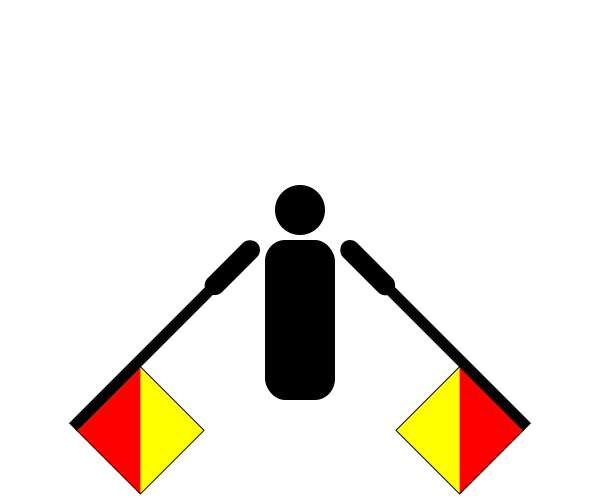
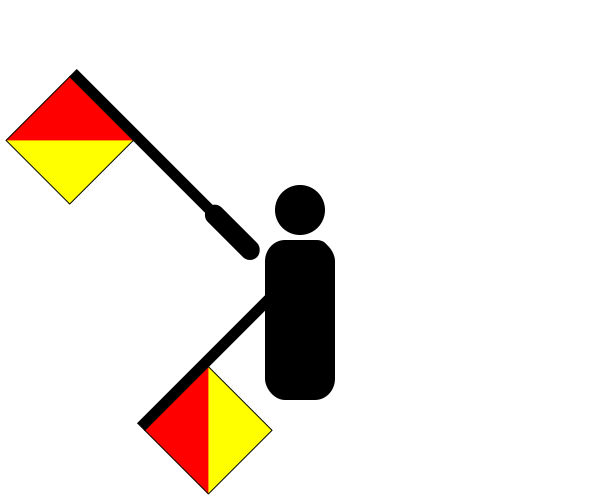
How to communicate the surname Anglin in...
Braille
⠁⠝⠛⠇⠊⠝
Morse
.--.--..-....-.
Semaphore



There are approximately 424 people named Anglin in the UK. That makes it one of Britain's least common surnames. Only around seven in a million people in Britain are named Anglin.
Origin: Celtic
Region of origin: British Isles
Country of origin: Ireland
Religion of origin: Christian
Language of origin: Gaelic