ALLENDER
Allender is a surname of English origin that has been documented in various forms across the British Isles and beyond. The name is associated with several distinct etymological pathways, each supported by historical records and linguistic analysis.
One scholarly explanation derives Allender from the Old English compound ealh, meaning “temple” or “hall”, combined with leah, meaning “clearing” or “meadow”. According to this view, the surname would have originally functioned as a locational indicator for an individual who lived near or worked at a temple or hall situated in a clearing. The construction of the name reflects a common practice in medieval England whereby people were identified by proximity to notable landscape features.
Another well-documented source indicates that the surname may have arisen from the Norman-derived personal name Alan, a Breton name that entered England following the Conquest of 1066. The addition of the suffix -ender could signify “son of” or “descendant of Alan”, thereby producing a patronymic form. This theory accounts for the popularity of the name during the medieval period and aligns with the existence of early records such as William Aletundere in Sussex in 1296 and Richard Alefounder in London in 1320.
A third hypothesis links Allender to an occupational origin, specifically the medieval title “ale‑founder”. The Old English words ealu (“ale”) and tendere (“to tend, to measure”) combined to denote a person who inspected ale measures and upheld fair trade. Over centuries, the occupational designation shortened and evolved in spelling— first appearing as Ale‑founder, later as Allfounder or Allfunder—before stabilising as Allender. Families adopting this name were historically situated in counties such as Kent and Sussex, where they held manorial status.
Recorded variants of the surname include Oland, Olland, Olin, Olanda, Olander, Ollander, Allander, and Allender. The earliest surviving parish entries appear in the diocese of Greater London in the mid‑seventeenth century, notably the christening of William Allander (later Allender) at St. Mark’s Church, Stoke Newington, on 22 February 1664. Earlier specimens such as Adam Olland in Spalding, Lincolnshire (19 December 1613) and George Allender in St. Sepulchre, London (15 April 1750) illustrate the diversity of spellings within the same family lines.
In modern times, the Allender surname can still be found throughout England, with clusters in Nottinghamshire and Lancashire. The name is also registered in the United States—particularly in Ohio, Indiana, and California—and in Australia. Migration during the colonial period, coupled with the persistence of the surname in rural communities, explains these contemporary distributions. Genealogical research, including examination of parish registers and civil documents, remains essential for determining the precise lineage and variant history of an individual family’s surname.
Typical given names associated with the Allender surname
Male
- Christopher
- David
- James
- John
- Michael
- Paul
- Peter
- Robert
- Stephen
- Steven
- Thomas
Female
- Christina
- Claire
- Clare
- Elizabeth
- Gemma
- Jayne
- Jean
- Jillian
- Kelly
- Laura
- Margaret
- Rebecca
- Susan
- Vittoria
Similar and related surnames
Related and similar names are generated algorithmically based on the spelling, and may not necessarily share an etymology.
How to communicate the surname Allender in...
Braille
⠁⠇⠇⠑⠝⠙⠑⠗
Morse
.-.-...-...-.-....-.
Semaphore


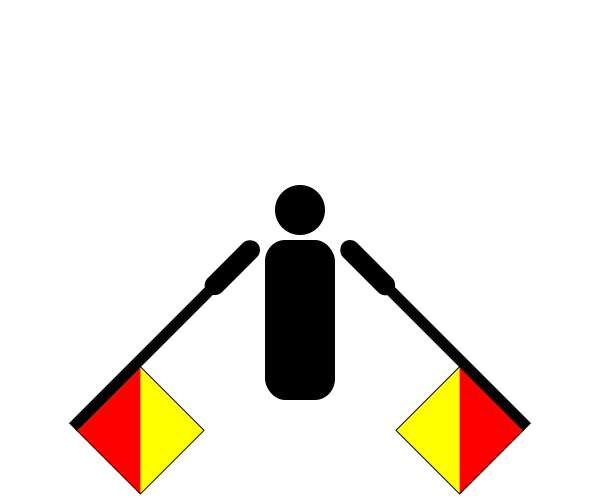

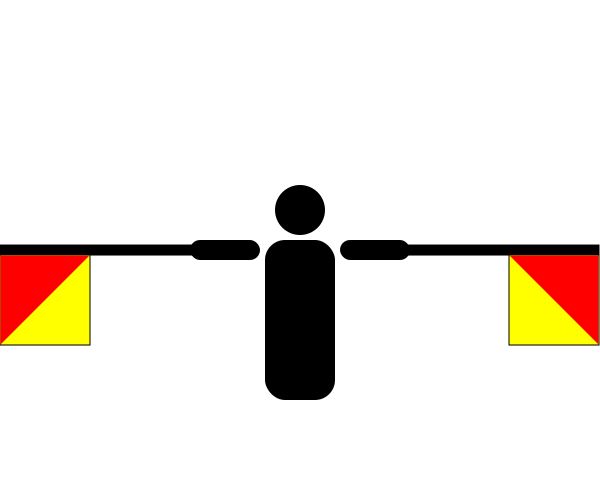
There are approximately 303 people named Allender in the UK. That makes it one of Britain's least common surnames. Only around five in a million people in Britain are named Allender.
Surname type: Occupational name
Origin: English
Region of origin: British Isles
Country of origin: England
Religion of origin: Christian
Language of origin: English

Famous people named Allender
- Paul Allender - Extreme metal guitarist
Names and descriptions courtesy of Wikipedia, and may contain errors. This is not intended to be an exhaustive list of every famous person with this name.