ALFORD
Alford is a surname of English origin, belonging to the class of locational names that identify an ancestor's place of origin. The name is derived from the Old English personal name Ealdfrith, meaning “old peace”. It denotes a person who hailed from one of several settlements named Alford in England.
The earliest forms of the surname that survive in the written record include Alforde, Aldeford and Allford. The variation of spelling reflects the lack of standardised orthography in medieval England. The name was recorded in the Domesday Book of 1086 under the form Alforde, referring to the village in Lincolnshire that now bears that name. The placename is explained by the Dictionary of English Place Names as “the ford by the temple”, that is, a river crossing near a place of pagan worship; a second, more probable meaning is “the ford by the alder trees”. In the Somerset settlement the name is recorded as “the ford of Ealdgyp”, a translation of “the ford of the old woman”. Both derivations involve the Old English word ford, meaning a shallow place where a river may be crossed.
Early evidence that the locative designation had become a family name appears in the 13th century. In 1273, John Alforde of Somerset is listed in the historical rolls known as “Kirby’s Quest”, while John de Aldeforde is recorded in the Hundred Rolls of the same year. These documents confirm that individuals bearing the name were recognised as distinct lines within their local communities.
In the early modern period the name grew in the south of England. Thomas Alford of Wiltshire was married to Benedicata Berrisford in 1634 at St George’s Chapel, Hanover Square, London. The following century, in 1763, Betty Alford married John Ruston at the same church. These records illustrate the spread of the family beyond its original locales, as well as its continued presence in the civil records of the English gentry.
Heraldic evidence for the Alford surname is recorded in the earliest extant arms: a red field featuring a silver cross moline. The cross moline, characterised by its forked ends, was a common motif in the armoury of medieval families. The blazon is preserved in early heraldic rolls associated with the family.
The first known instance of the surname in documentary form dates to 1184, when Robert de Aldeforde is mentioned in the Annales Cestrienses Rolls of Lancashire and Cheshire, compiled during the reign of King Henry I (1154–1189). This early reference establishes the antiquity of the name and its integration into the recorded history of England.
Typical given names associated with the Alford surname
Male
- David
- James
- John
- Mark
- Michael
- Paul
- Peter
- Richard
- Robert
- Stephen
Female
- Claire
- Emma
- Jane
- Julie
- Karen
- Margaret
- Mary
- Michelle
- Patricia
- Sally
- Sarah
- Susan
Similar and related surnames
Related and similar names are generated algorithmically based on the spelling, and may not necessarily share an etymology.
How to communicate the surname Alford in...
Braille
⠁⠇⠋⠕⠗⠙
Morse
.-.-....-.---.-.-..
Semaphore


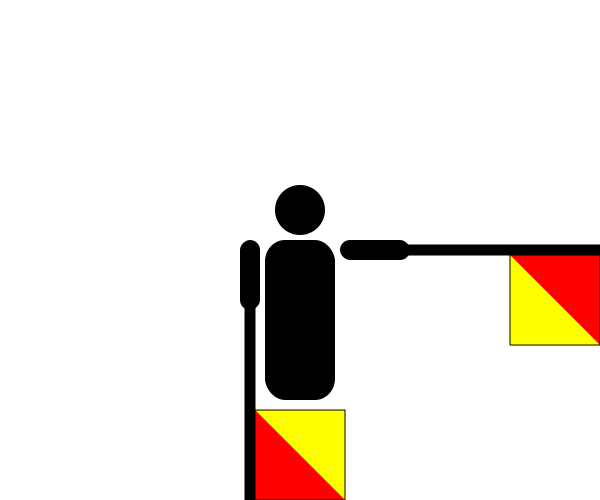
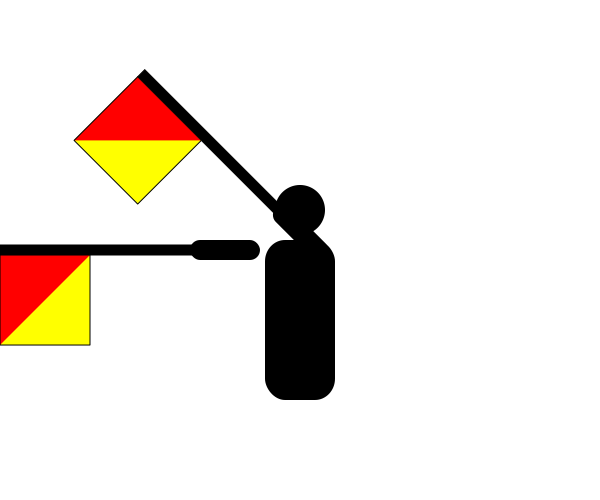
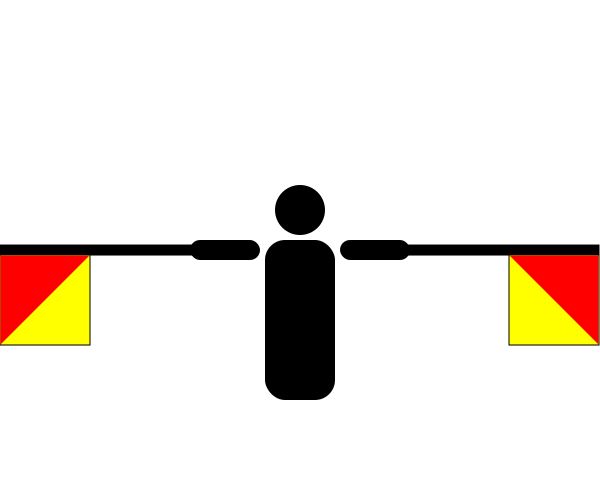

There are approximately 4,886 people named Alford in the UK. That makes it roughly the 1,932nd most common surname in Britain. Around 75 in a million people in Britain are named Alford.
Surname type: Location or geographical feature
Origin: English
Region of origin: British Isles
Country of origin: England
Religion of origin: Christian
Language of origin: English

Famous people named Alford
- John Alford - Scottish-born English actor
- John Alford - Cricketer
- Carl Alford - Football player
- Jim Alford - Welsh middle-distance runner and athletics coach (1913 to 2004)
Names and descriptions courtesy of Wikipedia, and may contain errors. This is not intended to be an exhaustive list of every famous person with this name.