ALBIN
The surname Albin has its roots in the Germanic peoples of Continental Europe and in the Latin language. The personal name Albin is derived from the Latin Albinus, which directly translates to “white” or “fair”. In medieval Europe this personal name was often conferred upon individuals whose hair or complexion was unusually light, and it later developed into a hereditary surname.
Among the early recorded uses of the name there are both English and French examples. In England the first documented spelling of the family name is that of Roger Albin, recorded in 1194 in the Pipe Rolls of Worcestershire during the reign of King Richard I. In France the name appears as Gilbert Aubin (1210, Curia Rolls, Norfolk) and John Obin (1275, Subsidy Rolls, Worcester), illustrating the close relationship between the spellings Aubin and Obin in medieval documents.
The French origin of the name is often described as medieval and derives from the Old French word albin or aubin, meaning “white”. This nickname surname was frequently applied to people with exceptionally fair hair. The name also occurs as a Christian saint name; a notable figure is St. Aubin, bishop of Angers in the mid‑sixth century. The popularity of the name in France was further reinforced by the Germanic personal name Albuin, a compound of the elements alb “white”, elf and win “friend”.
In Scotland the surname Albin has an occupational dimension: it is believed to denote a baker. This occupational sense has given rise to several Scottish variants such as Ailpin and Alpyn. The name has been echoed across the British Isles, particularly in the Midland counties of Lancashire, Yorkshire, Derbyshire, Nottinghamshire and Leicestershire.
Throughout Europe the surname is common in several countries. In France it is held by more than three thousand individuals, whereas in the United Kingdom it is especially prevalent in northern and midland regions. The name is also found in Canada, the United States (notably in eastern states such as New York, Pennsylvania and Massachusetts), and in a few Latin American countries including Mexico, Peru and Brazil.
Spelling variants of the surname are numerous, reflecting the linguistic diversity of the regions in which it has evolved. English forms include Albyn and Elbin, French forms such as Aubin, Auban, Alvin and Alven, and Germanic adaptations like Aubben and Alpen. In Dutch records one encounters forms such as Aalbijn and Aalbino.
The etymological connection of Albin to the word albus in Latin explains its semantic association with a white or pale complexion. This semantic note confirms the origin of the name as a descriptive nickname that later became hereditary. The persistence of the surname over many centuries, together with its geographic spread, illustrates a family tradition that has survived into the present day.
Typical given names associated with the Albin surname
Male
- Albert
- Ben
- Christopher
- David
- Frederick
- James
- Jeremy
- John
- Michael
- Peter
- Richard
- Roland
- Steven
Female
- Caroline
- Charlotte
- Diane
- Doreen
- Elizabeth
- Heather
- Janet
- Karen
- Linda
- Lucia
- Margaret
- Sarah
- Shelley
- Susan
Similar and related surnames
Related and similar names are generated algorithmically based on the spelling, and may not necessarily share an etymology.
How to communicate the surname Albin in...
Braille
⠁⠇⠃⠊⠝
Morse
.-.-..-.....-.
Semaphore


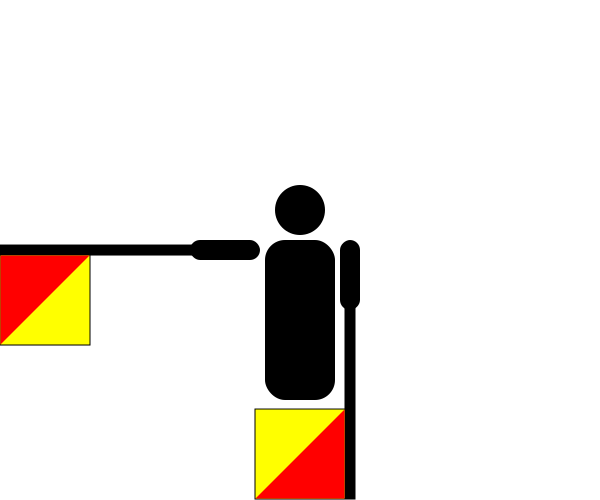
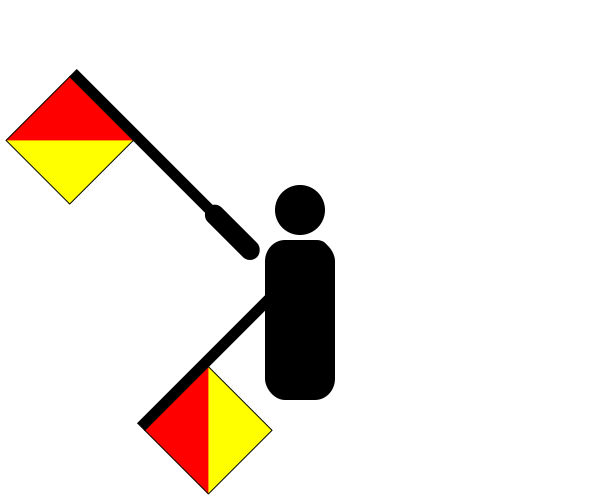
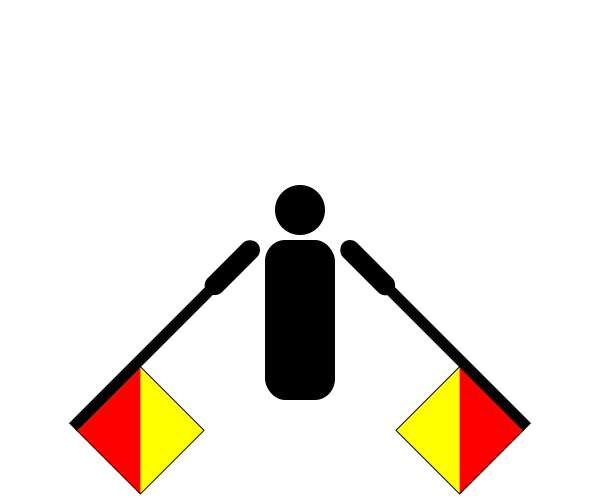
There are approximately 244 people named Albin in the UK. That makes it one of Britain's least common surnames. Only around four in a million people in Britain are named Albin.
Origin: English
Region of origin: British Isles
Country of origin: England
Religion of origin: Christian
Language of origin: English
