AIREY
Airey is a surname of English provenance with roots that extend back to the Old Norse personal name Eiríkr, a term that translates literally as “eternal ruler” or “ever powerful.” The name is therefore a patronymic indicator, originally applied to those who were the descendants of an individual named Eiríkr. Over the centuries the patronymic presumption has been discarded in favour of a locational or topographical identifier, as historical evidence shows that the surname also derives from geographical features in north‑west England.
The locational theory links the surname to places such as Aira Beck or Aira Force near Ullswater in Cumberland, or to other unrecorded sites that incorporated the Old Norse word eyrara, describing a gravel‑bank stream or river. By extension the name could have been bestowed on a person who resided near such a stream, a practice that was common amongst settlers who travelled from their place of birth and required a new form of identification. The surname is also sometimes considered topographical, in that it may dictate residence by a gravel‑bank or even a shieling— a summer hut of turf or bark used by cowherds, an element that dates to the Viking settlement of the region in the 10th and 11th centuries.
Because of regional dialectal differences and varying literacy standards, the name has produced a wide array of orthographic variants. Contemporary spellings include Airey, Airy, Ayre, Aery, Erie, Eyre, Errey, Earie and Earey. Early records under these forms appear throughout the late medieval period: Clemens Erie (1576, Lancashire); Robert Erye (1584, Lancashire); Thomas Eray (1591, Cumberland); and William Earee (1685, London). Church registers contain further examples, including the christening of Anges Earay (Dacre, Cumberland, 19 September 1633) and the marriage of Mary Earey to Benjamin Buskin (St Bartholomew the Great, London, 2 October 1726).
The earliest documented instance of the family name is that of Robert de Hayra, dated 1301 in the “Inquisitiones Post Mortem” of Lancashire, a record compiled during the reign of King Edward I, who reigned from 1272 to 1307. This evidence supports the notion that the name was already in use as a surname over seven centuries ago, firmly establishing its long‑standing presence in English society.
In addition to the Norse‑derived origin, some historical sources propose that the surname arose through Norman influence, possibly derived from a toponym near Aire, France (now Arras). The French word “aire”, meaning “orientation” or “direction”, could have been applied as a nickname to individuals who adopted a new path or direction in life. This Norman hypothesis suggests that bearers of the name might have arrived in northern England during the Norman Conquest of 1066. Whether this interpretation can be conclusively proven remains uncertain, but it is repeatedly cited in scholarly accounts of the name’s early history.
In the Middle Ages, a man who bore the name Airey was sometimes referred to as an “Aireyman”, a term that reflected the surname’s role in denoting social identity. The surname is most frequently encountered in the counties of Lancashire, Yorkshire and Greater Manchester in England, with clusters in rural towns such as Lathom, Wheelton and Adlington, as well as in larger urban centres like Blackburn and Preston. Its distribution is reflected in the wider diaspora of people who migrated to former British colonies: Ireland, Australia, New Zealand, South Africa and Canada all contain populations whose ancestry can be traced back to the Airey line.
Overall, the surname Airey exemplifies the complex interweaving of linguistic and geographical factors that have shaped family names in Britain. Its dual heritage— patronymic and locational – and its persistence across centuries and continents attest to the enduring nature of surnames as records of migration, settlement and identity. The existence of many spelling variations throughout historical documents demonstrates both the fluidity of orthography in the pre‑standardised era and the influence of regional dialects on the perpetuation of this distinctive name. The common presence of the Airey lineage in contemporary Britain and former colonies offers a living link to a heritage that traces its roots to both Norse entrepreneurs and the Norman imperatives of medieval England.
Typical given names associated with the Airey surname
Male
- Christopher
- David
- James
- John
- Matthew
- Michael
- Paul
- Richard
- Robert
- Stephen
- William
Female
- Catherine
- Dawn
- Doris
- Elizabeth
- Helen
- Jane
- Jm
- Joanne
- Karen
- Louise
- Margaret
- Mary
- Michelle
- Nutan
- Susan
Similar and related surnames
Related and similar names are generated algorithmically based on the spelling, and may not necessarily share an etymology.
How to communicate the surname Airey in...
Braille
⠁⠊⠗⠑⠽
Morse
.-...-..-.--
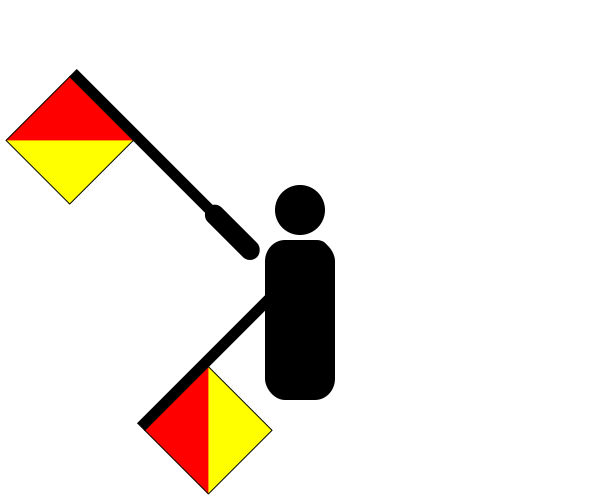
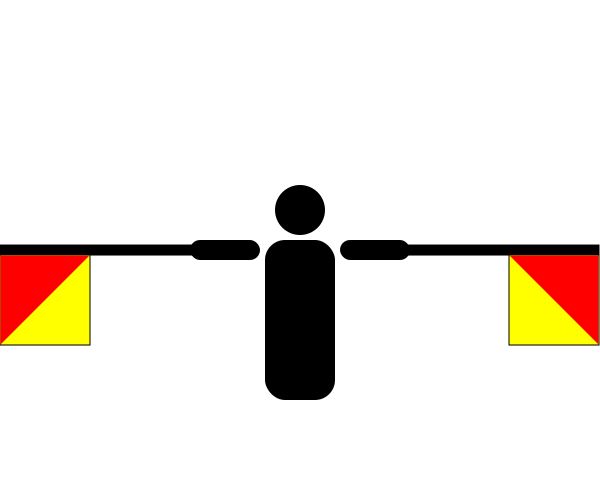
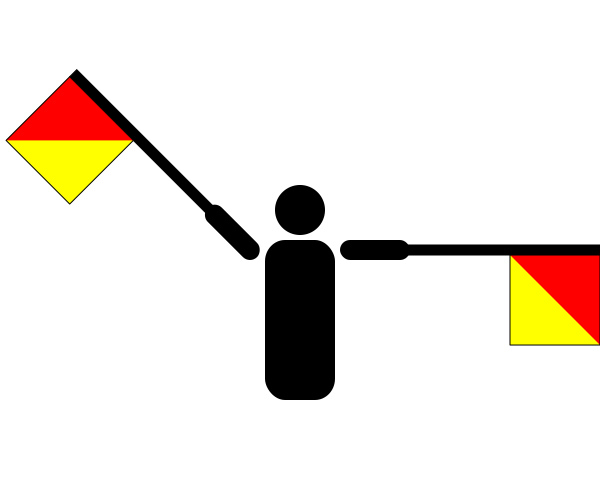
Semaphore


There are approximately 3,626 people named Airey in the UK. That makes it roughly the 2,540th most common surname in Britain. Around 56 in a million people in Britain are named Airey.

Famous people named Airey
- Don Airey - Keyboardist, rock musician
- Dawn Airey - Commercial television executive
- Phil Airey - Football player
- Terence Airey - Army general (1900 to 1983)
- Stuart Airey - Cricketer
- Stuart Airey - Lawn bowler
- James Airey - Cricketer
- Henry Parke Airey - Australian colonial soldier (1842 to 1911)
- Peter Airey - Member of the Queensland Legislative Council (1865 to 1950)
Names and descriptions courtesy of Wikipedia, and may contain errors. This is not intended to be an exhaustive list of every famous person with this name.