AINSCOUGH
Ainscough is a locational surname traditionally associated with the county of Lancashire in the north‑west of England. The name is believed to have arisen from a now–lost hamlet that once stood in the region, and it has been recorded in parish registers and legal documents dating back to the early fourteenth century.
In terms of etymology, the name incorporates elements of both Old Norse and Old English. The first component is the Old Norse personal name Einarr or, in a later form, Eindriði, which was common among Scandinavian settlers in the Danelaw. The second component is the Old English word cog or cogh, meaning a hill or mound. Together, the construction can be interpreted as “Einarr’s hill” or “Eindriði’s mound,” suggesting that the original bearer of the name lived near or owned a hill associated with the Norse settler.
Alternative explanations note that the place‑name itself may derive from the Old Norse einn “solitary” combined with skóg “wood,” giving a meaning akin to “the wood standing alone.” This view emphasises the geographical character of the landscape rather than personal ownership, but it reflects the same underlying Norse influence that is evident in many northern English toponyms.
The earliest documented instance of the surname appears in the year 1327, when an individual named Robert de Ainscough was recorded in a Lancashire charter under the reign of King Edward III. A later milestone occurs on 17 January 1550, when the name is spelt Aynscow in a marriage record for Kateryn Aynscow and John Brindill at Chorley, Lancashire. During the early modern period, the name was listed in several church registers, including the christening of Anna Ainscough on 20 July 1625 at St. John’s in Preston.
Spelling variations have remained surprisingly consistent over the centuries, with the most common forms being Ainscough, Ainscow, and Ainscoe. Earlier forms such as Ainscaw, Aynscough, Antiscough, and occasionally Einco are sometimes encountered in medieval documents. These differences reflect the lack of standardised spelling in early English orthography rather than distinct family lines.
While the surname is predominantly found in Lancashire and the broader north‑west of England, migration has carried bearers of the name throughout the United Kingdom and beyond. Records indicate a modest diaspora to Australia, New Zealand, Canada, and the United States, mirroring broader patterns of British emigration in the eighteenth and nineteenth centuries. Comparatively, Ainscough remains an uncommon surname, ranking far lower in frequency than the most prevalent English surnames.
Typical given names associated with the Ainscough surname
Male
- David
- James
- John
- Mark
- Michael
- Paul
- Peter
- Richard
- Stephen
- Thomas
- William
Female
- Claire
- Emma
- Jane
- Joan
- Julie
- Margaret
- Mary
- Nicola
- Patricia
- Rebecca
- Sarah
- Susan
- Victoria
Similar and related surnames
Related and similar names are generated algorithmically based on the spelling, and may not necessarily share an etymology.
How to communicate the surname Ainscough in...
Braille
⠁⠊⠝⠎⠉⠕⠥⠛⠓
Morse
.-..-....-.-.---..---.....
Semaphore

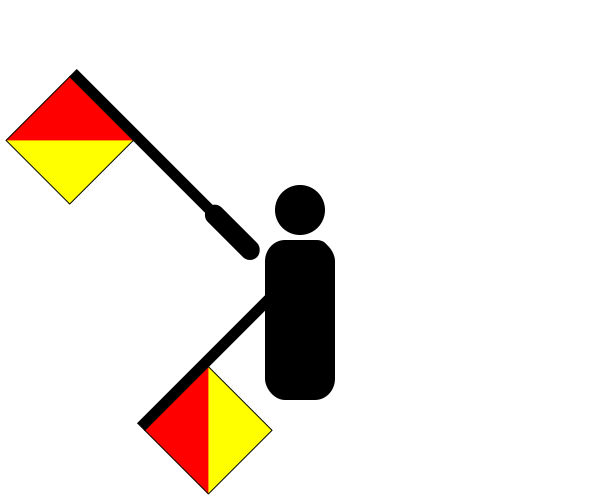
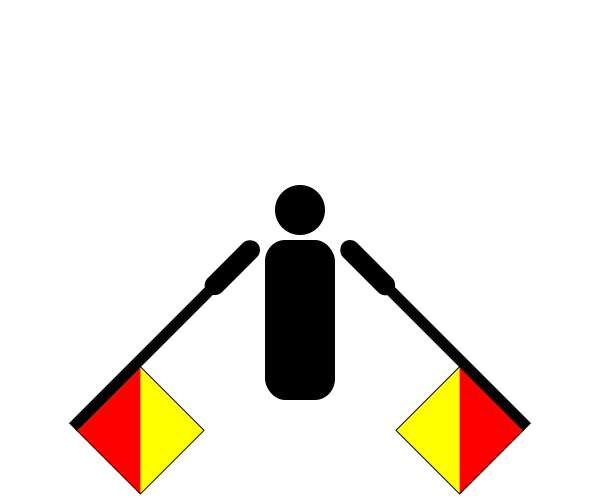


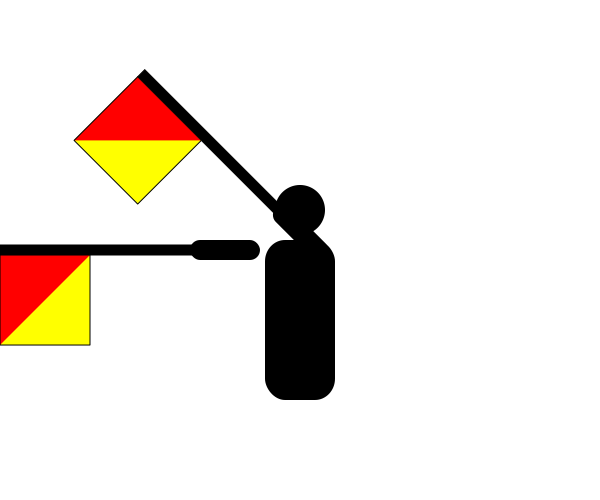


There are approximately 1,985 people named Ainscough in the UK. That makes it roughly the 4,241st most common surname in Britain. Around 30 in a million people in Britain are named Ainscough.
Origin: English
Region of origin: British Isles
Country of origin: England
Religion of origin: Christian
Language of origin: English

Famous people named Ainscough
- Thomas Ainscough - Cricketer (1865 to 1927)
- Shaun Ainscough - Rugby league player
- Gerry Ainscough - Rugby player
Names and descriptions courtesy of Wikipedia, and may contain errors. This is not intended to be an exhaustive list of every famous person with this name.