AHRENS
Ahrens is a surname of German origin, traditionally used as a patronymic to denote descent from an ancestor whose given name was Arnold or its Low German variant Arend. The medieval personal name Arnold is formed from the elements arn meaning ‘eagle’ and wald meaning ‘rule, power’, so that the surname Ahrens may be understood as ‘son of Arend’, or more broadly ‘descendant of the eagle‑rule’. The suffix s functions as a patronymic marker, a common feature of German surnames indicating lineage.
Historical records substantiate the long presence of the name within the German states. One of the earliest documented spellings appears in the christening register of August 1562, where the witnesses Johannis and Dorothea Arnt are recorded at Braunsberg in Old Prussia, during the reign of Maximilian I, Holy Roman Emperor. This early example demonstrates the variation Arnt, a precursor to the modern Ahrens. Later, the name survives in a church transaction dated 1645, when Wind Arend married Iischen Caups in Heiden Lippe, signalling the persistence of the Low German form Arend in northern Germany.
By the early eighteenth century the surname had spread beyond the borders of the Germanic world. A christening entry of 1709 records Trine, daughter of Johan and Margreta Ahrens, at Alt Bukow in Mecklenburg‑Schwerin, indicating a settled presence in the northern German provinces of Pomerania and Westphalia. In the same period, the name entered English parish registers. In 1765 the christening of Joanna Sabina, daughter of Christopher and Joanna Ahrens, is noted in St. Martin in the Fields, Westminster, London. This suggests the migration of families bearing the name to England, likely during the waves of continental migration that characterised the reign of the eighteenth century.
In Scandinavia, the name was occasionally applied in a slightly different context. Sigrid Gunilla Ahrens is recorded as marrying Victor Axel Evald Roos in Uppsala in 1866, a testament to the name’s penetration into Swedish society. The connection here emphasizes the dual origin of the surname: on the one hand it functions as a patronymic in Low German contexts, while on the other it can derive from the Swedish element arende, meaning tenancy or leasehold, a status name given to tenant farmers. The dual meanings reflect the linguistic flexibility and social significance of surnames within the Germanic world.
The heraldic tradition provides another perspective on the name’s heritage. A coat of arms granted to an Ahrens family at Riga depicts a male figure standing on a green base, his right hand on his hip and his left hand holding three green ears of corn. The figure is belted with a wreath of ivy, and the crest shows three ears of corn. While heraldry does not always reveal genealogical information, it does show that the name was associated with families of note in the Baltic region, indicating a wider geographical dispersion of the surname during the early Modern period.
In the modern era, the surname remains most prevalent in Germany, especially within the Lower Saxony and North Rhine‑Westphalia provinces, where the population density is high and German immigration historically took place. Variants of Ahrens appear throughout German-speaking territories, including Ahren, Aren, Ahron, Ahrin, and others, reflecting regional orthographic preferences and phonetic renditions. In the Netherlands, where North German dialects overlap linguistic borders, the surname is also common, frequently appearing in municipal records of Schleswig-Holstein and surrounding regions.
Notable bearers of the surname have made contributions in various fields. Lynn Ahrens, an American playwright and lyricist, has received acclaim for her work on Broadway, while Heinrich Ahrens, a German physicist, is remembered for his research in the twentieth‑century scientific community. These contemporary figures demonstrate the continued cultural and intellectual significance of the name.
In addition to the patronymic meaning, some scholars note a possible locational origin linked to the town of Hadria in northern Italy, the namesake of the Adriatic Sea. The medieval practice of referring to individuals as ‘arancia’ or ‘Adriaan’ reflects a regional identification that could have been adopted in German contexts, subsequently evolving into the surname Ahrens. While this theory is less frequently cited, it exemplifies the complex pathways through which surnames may arise and transform.
Overall, the surname Ahrens embodies a rich tapestry of linguistic roots, geographical movements, and social developments. Its endurance across centuries, from early German records to contemporary bearers worldwide, marks it as a testament to the continuity of family identity within the Germanic tradition.
Typical given names associated with the Ahrens surname
Male
- Andreas
- Daniel
- David
- Edward
- Gary
- James
- John
- Michael
- Richard
- Robert
- Stuart
- Thomas
- Uwe
Female
- Alexandra
- Claire
- Dani
- Eileen
- Heidi
- Jane
- Jennifer
- Joanne
- Julia
- Louise
- Sarah
- Stephanie
- Susan
- Valerie
Similar and related surnames
Related and similar names are generated algorithmically based on the spelling, and may not necessarily share an etymology.
How to communicate the surname Ahrens in...
Braille
⠁⠓⠗⠑⠝⠎
Morse
.-.....-..-....
Semaphore


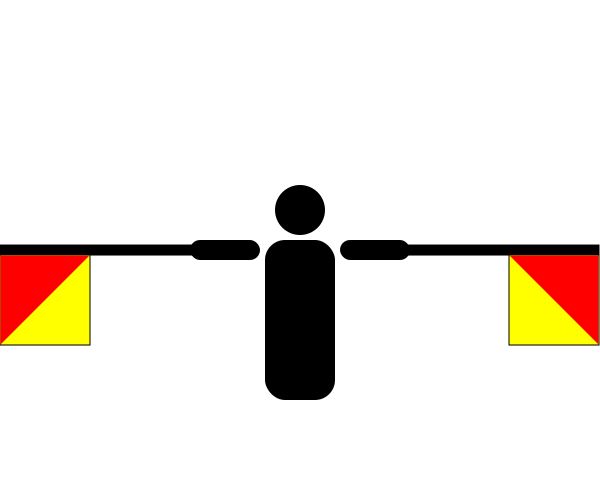

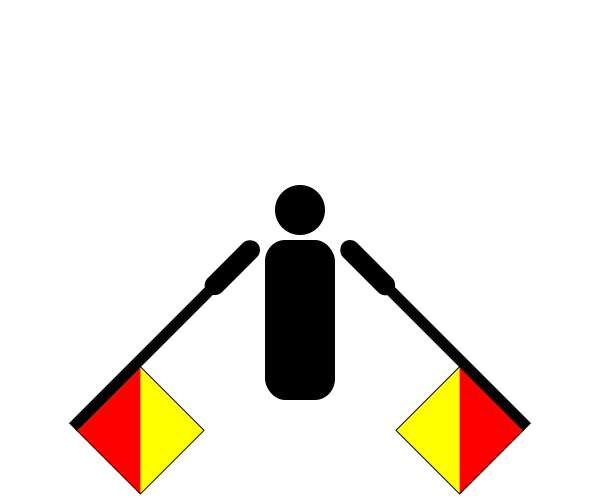

There are approximately 207 people named Ahrens in the UK. That makes it one of Britain's least common surnames. Only around three in a million people in Britain are named Ahrens.
Region of origin: Europe
Country of origin: Germany
Language of origin: German
