ADAN
Adan is a surname of Arabic origin, derived from the given name Adam, which in Hebrew denotes the first human being and the word for “man” or “earth”. The etymology reflects a spiritual connection with the biblical figure and conveys a sense of humanity and earthly origin. The name is particularly common among Muslims, where it is seen as a link to the prophet Adam.
The earliest medieval European records trace the surname back to England. It appears in the Domesday Book of 1086, where it is listed as a family name unrelated to any specific place. The first English record of the element Adam is found in the Hundred Rolls of Cambridgeshire in 1273, during the reign of Edward I. Subsequent medieval mentions include Adam, sub‑prior of Melrose Abbey in Scotland, who became abbot of Cupar in 1189, and Alianor Adam, recorded in the 1281 Assize Rolls of Cheshire. These attestations confirm that surnames derived from the given name Adam were among the oldest and most widespread in medieval Britain.
In Spain the surname has been documented since the early modern period. Made known as a top‑300 surname across Spanish‑speaking families, it is particularly common in Latin America. In Mexico it ranks within the top 50 surnames, with strong concentrations in the states of Oaxaca and Veracruz where it is among the ten most frequent names. In Spain it is listed among the top 100, reflecting a broad geographic spread. Spanish usage also includes variants such as Adão, Adanero, and Adanob; the root remains the same.
Adan also appears in French, Italian, German, and other European languages. The surname is recorded in more than seventy spellings, among them Adami, Adamo, Adamsson, Adamsen, Dami, Adamski, Adnett, Adekins, Ade, Aitken, and Aick, Adamovic. These variants show the adaptability of the base name to local phonology and orthographic conventions. Some forms, such as McAddie and Keddie, indicate Celtic influence, while others, including Adamec, Adamky, and Adamczyk, reflect Slavic usage.
Beyond the Arabic and European contexts, Adan has been adopted by communities with Spanish heritage in the United States, particularly in the Southwest and along Florida’s southeastern coast, as well as by Filipino families with Spanish ancestry in the Philippines and Guam. In some Asian, African, and Indian locales the name appears in transliterated forms such as Aadan, Aadann, and Edan. These instances illustrate the surname’s global reach owing to migration and colonisation.
The name’s meaning extends beyond the biblical reference. In Spanish contexts it can denote “earth”, “red” or “man”, while Latin derivations such as adiutor – meaning “helper” – suggest a spirit of aid and support. Other Latin words, like adnasci meaning “to be born”, imply the emergence of something special from the earth. These semantic layers reinforce the symbolic importance of the surname as a reminder of shared origins and communal solidarity.
Overall, the surname Adan is a historically grounded, cross‑cultural marker that carries both a religious heritage and a linguistic legacy spanning continents and centuries.
Typical given names associated with the Adan surname
Male
- Abdi
- Abdirahman
- Ahmed
- Ali
- Ayan
- Gulaid
- Hasan
- Hassan
- Ibrahim
- Mohamed
- Mohammed
- Mohamoud
Female
- Amal
- Amina
- Asha
- Charlotte
- Durr-e
- Emma
- Halima
- Hawa
- Khadija
- Khadra
- Linda
- Nasra
- Nimo
- Sahra
- Simone
Similar and related surnames
Related and similar names are generated algorithmically based on the spelling, and may not necessarily share an etymology.
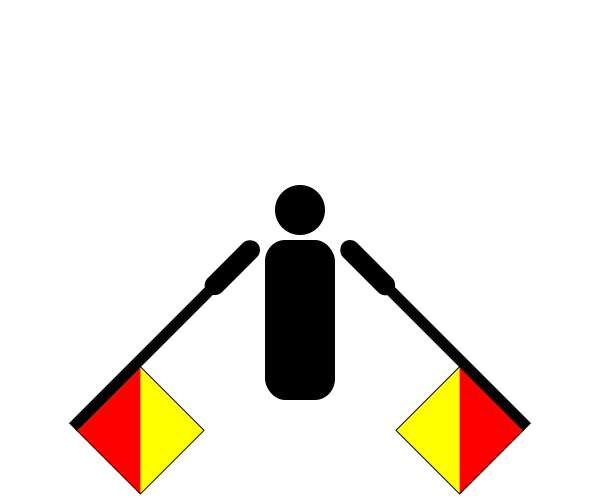
How to communicate the surname Adan in...
Braille
⠁⠙⠁⠝
Morse
.--...--.
Semaphore


There are approximately 618 people named Adan in the UK. That makes it one of Britain's least common surnames. Only around nine in a million people in Britain are named Adan.
Origin: Iberian
Region of origin: Europe
Country of origin: Spain
Religion of origin: Muslim
Language of origin: Spanish
