ADAMI
The surname Adami finds its roots in the Hebrew personal name Adam, which is taken from the word Adamah meaning “earth” or “red earth”. The name was brought into later European usage as a patronymic appellation, signifying descent from an individual called Adam.
In Italy the name is highly regarded and widely documented. It is thought to have evolved from the Roman clan name Adamo, itself a form of the Latin verb Adamare, meaning “to love” or “to approve of”. The surname is traditionally associated with virtues such as generosity, resilience and strength, and it has long been linked to the biblical figure of Adam, the first man.
Recorded usage of the surname extends beyond Italy. In England it appears in the Domesday Book of 1086 and in the Hundred Rolls of 1273, indicating an early presence in the country. In Scotland a man named Adam served as sub‑prior of Melrose Abbey and later became abbot of Cupar in 1189. Members of the surname in Britain may trace their ancestry to French Huguenot refugees who fled religious persecution in the 18th century, with witnesses recorded at the French Huguenot Church in London in 1731.
Contemporary distribution shows that the surname is common chiefly in Italy, Switzerland and France. In Italy it is most often found in the northern provinces of Piedmont, Lombardy, the South Tyrol region (Bolzano) and the Swiss canton of Ticino. Recent estimates place the global population bearing the name at approximately thirty‑five thousand. In the United States the name is comparatively rare, with fewer than five hundred individuals recorded, largely concentrated in metropolitan areas with significant Italian communities.
Among those who have achieved distinction bearing this name are the Italian neurosurgeon Ugo Adami and the Italian painter Corrado Adami. Their professional accomplishments contribute to the name’s reputation for cultural and intellectual achievement.
The surname has a wide array of orthographic variants that arise from regional linguistic influences. In the Italian sphere the name appears as Adamo, Adamini, Adamini, Adamucci and others. In Germanic countries it is rendered as Adamson, Adamsen, Adami and Adamush. Slavic forms include Adamowicz, Adamovici and Adamczyk. In the Iberian Peninsula common spellings are Ádami and Adamí. Across France it appears as Adam, Adamek and Adamé. Thus, while orthography varies, all forms share the same etymological origin, denoting “son of Adam”.
In sum, the surname Adami carries a legacy that spans antiquity and modernity, geography and culture, and it continues to be a marker of lineage, tradition and personal identity across Europe and the diaspora. Its rich historical tapestry is reflected not only in the facts recorded in early legal and ecclesiastical documents but also in the lives of those who continue to bear it today.
Typical given names associated with the Adami surname
Male
- David
- Dino
Female
- Rachel
Similar and related surnames
Related and similar names are generated algorithmically based on the spelling, and may not necessarily share an etymology.
How to communicate the surname Adami in...
Braille
⠁⠙⠁⠍⠊
Morse
.--...---..
Semaphore


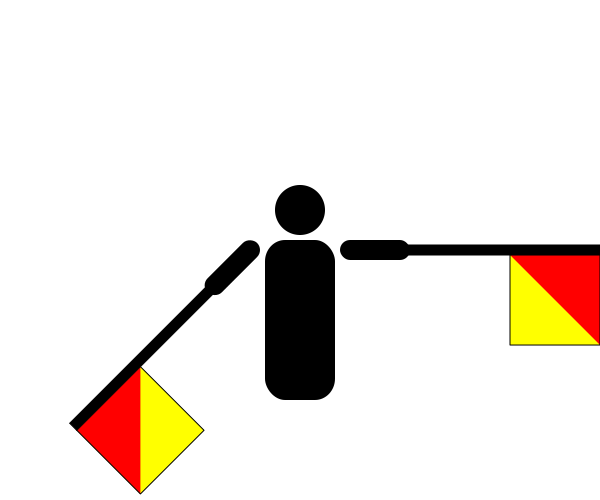
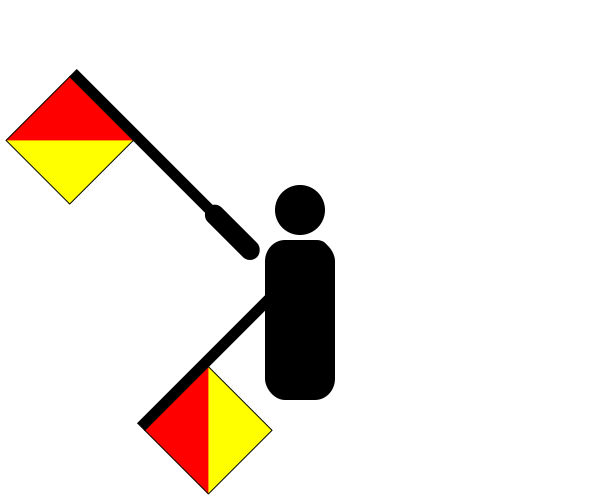
There are approximately 102 people named Adami in the UK. That makes it one of Britain's least common surnames. Only around two in a million people in Britain are named Adami.

Famous people named Adami
- John George Adami - Pathologist (1862 to 1926)
Names and descriptions courtesy of Wikipedia, and may contain errors. This is not intended to be an exhaustive list of every famous person with this name.