PRIER
Prier is a surname that appears to have developed independently in both French and Anglo‑Saxon contexts, reflecting the common medieval practice of forming names from occupations or personal characteristics.
In French, the name derives from the verb prier, meaning “to pray.” It was likely originally a nickname for a person noted for his devoutness or for someone who performed a religious duty, such as a monk, priest or other ecclesiastical function. The surname has been documented in French‑speaking areas since at least the 13th century, and its spelling has remained largely stable, with occasional variants such as Priere and Prier.
The Anglo‑Saxon derivation comes from the Old English pre‑7th century word prior, a term applied to a monastic official who was directly subordinate to an abbot. As an occupational surname it denoted the servant or under‑mander of a prior. This usage is recorded as early as 1205 in the Curia Regis Rolls of Suffolk, where the name appears as Roger Priur. Subsequent medieval records, such as the 1237 Feet of Fines of Cambridgeshire and the 1268 Assize Court Rolls of Somerset, preserve earlier spellings including le Priur and le Prior. Over time the spelling simplified to Prier, and related forms such as Prior, Pryer and Pryor also emerged.
Early citations indicate a residential distribution centred on eastern and northern France and the surrounding Franco‑Belgian border counties. The surname is the 425th most common in France, appearing in roughly 1,500 communes, with a concentration in the capital and in areas adjoining Luxembourg. In Luxembourg the name accounts for close to twelve per cent of the population, whereas in Belgium it is considerably rarer. Outside Europe the surname appears sporadically; in the United States census the name is recorded for fewer than 4,000 individuals, most frequently in states along the eastern seaboard such as New York, New Jersey and California.
A heraldic device associated with the name depicts three red chevron‑els on an ermine‑belt, flanked by four gold wavy eight‑pointed stars; the crest is a single star. The family motto, “Malo mori quam feodari,” translates as “I would rather die than be disgraced,” a phrase reflecting the martial or religious ethos often linked to the surname’s origins.
In sum, the surname Prier demonstrates how a single name can arise from distinct linguistic and cultural roots, each reflected in its earliest medieval records, its distribution in modern populations, and its symbolic heraldry. The name remains a testament to the enduring influence of occupation and piety in the formation of family identities across Europe.
Typical given names associated with the Prier surname
Male
- Richard
Female
Similar and related surnames
Related and similar names are generated algorithmically based on the spelling, and may not necessarily share an etymology.
How to communicate the surname Prier in...
Braille
⠏⠗⠊⠑⠗
Morse
.--..-.....-.
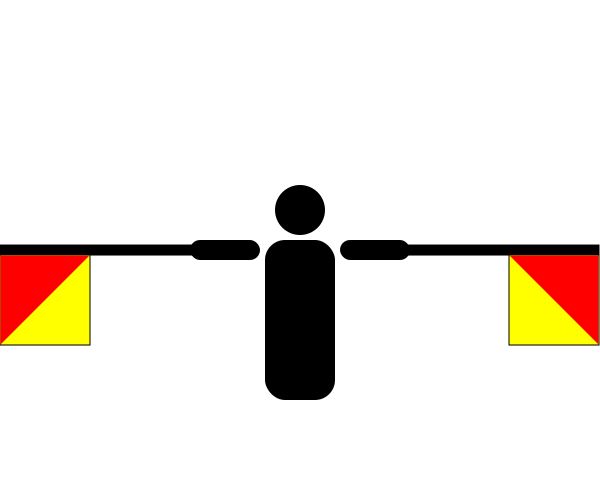
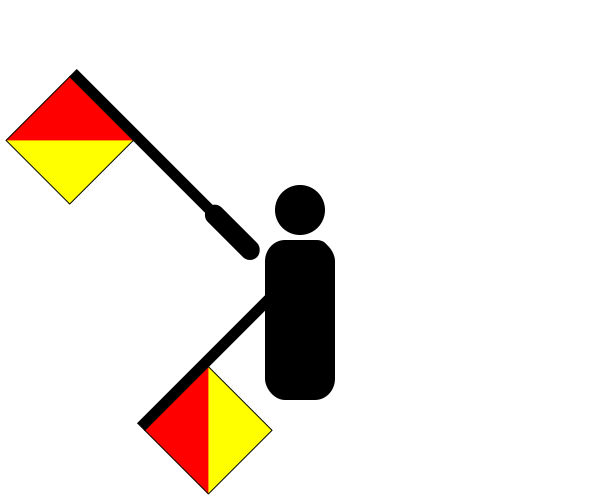
Semaphore


There are approximately 71 people named Prier in the UK. That makes it one of Britain's least common surnames. Only around one in a million people in Britain are named Prier.
