MCMILLIAN
Recorded variant spellings include Mc Millian, Mcmillian
McMillian is a surname of Gaelic origin that is found primarily in the British Isles and, through migration, throughout the world. The name is a patronymic construction, with the Gaelic prefix mac meaning “son of” and the suffix derived from maol, a term for a tonsured or bald person, typically a cleric. Combined, the original form MacMhaolain translates literally to “son of the tonsured one.”
In the 13th century the surname appears in the form Gillemor Macmolan (1263), recorded as a juror on an inquest in Lanarkshire during the reign of King Alexander III of Scotland. Subsequent documents illustrate the name’s persistence and geographical spread. Sir Duncan Macmolane, listed as a Knight of the Pope, is documented in Edinburgh in 1452, while an individual named John Makmilane served as a bailie of Glasgow in 1454. Parish registers further provide evidence of the name’s usage in the 18th and 19th centuries, including the marriage of Janet McMillian to Abraham Gray on 2 December 1721 in Inveresle, Midlothian, and the christening of William McMillian, son of William McMillian, on 21 November 1750 in Edinburgh.
The evolution of the surname is closely linked to the orthographic practices of early Gaelic scribes. The original Old Gaelic term Macghillemhaoil – meaning “son of the servant of the tonsured one” – was later contracted to Macmhaolain. This linguistic development produced a range of contemporary spellings, including McMillan, MacMillan, McMullen, McMullan, McMullin, McMillen, and McMilan. The interchangeable use of the prefixes Mac and Mc reflects their identical meaning, “son of.” In some cases, the initial prefix was omitted altogether, resulting in derivations such as Millan, Millen, and Millin.
Although the surname’s core meaning remains the same across its variants, its social connotations have broadened. In medieval Scotland, a tonsured individual was often associated with religious devotion; the surname could therefore denote descent from a cleric or a devotee of a saint such as St. Fillan, an Irish hermit who migrated to Scotland in the seventh century. The occasional reference to a “devotee of St. Fillan” underscores the religious undertones that have accompanied the name since earliest times.
In the contemporary era, the McMillian surname is most frequently encountered in the United States, particularly in the southern states, and remains common in Scotland and Northern Ireland. Once recorded in the Hebridean islands of western Scotland, the name has followed widespread patterns of migration, leading to its presence in a variety of English‑speaking countries. The multiplicity of spelling variants is a direct consequence of early phonetic transcription practices as well as deliberate alterations by emigrant families seeking to assimilate or avoid persecution in new environments.
Typical given names associated with the McMillian surname
Male
- Allan
- George
- James
- John
- Stephen
Female
- Ellen
- Fiona
- Sheila
- Susan
Similar and related surnames
Related and similar names are generated algorithmically based on the spelling, and may not necessarily share an etymology.
How to communicate the surname McMillian in...
Braille
⠍⠉⠍⠊⠇⠇⠊⠁⠝
Morse
---.-.--...-...-.....--.
Semaphore
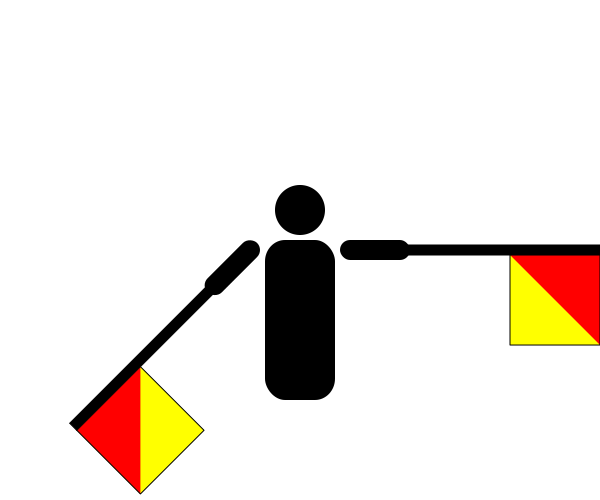

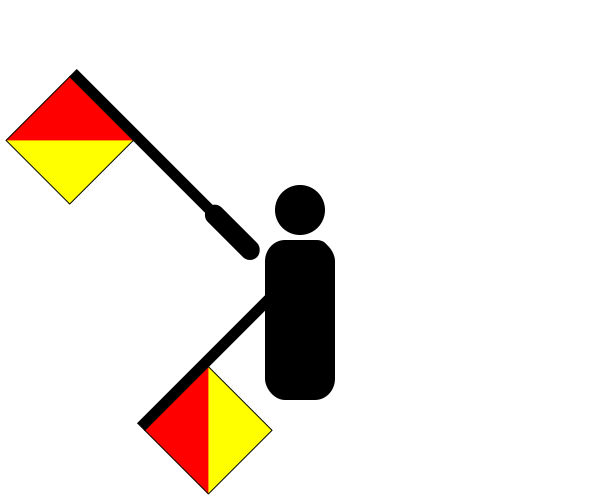


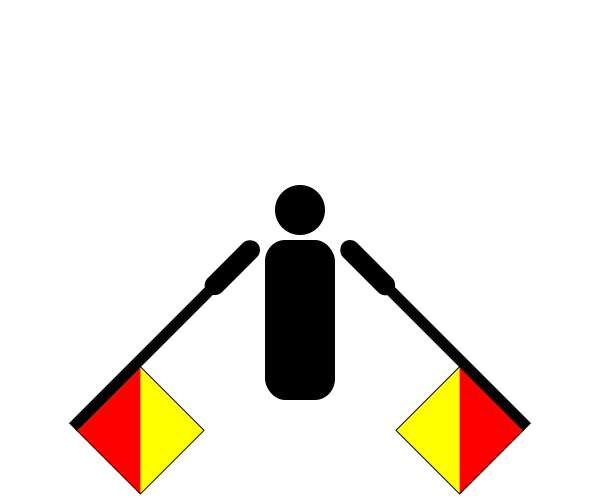
There are approximately 96 people named McMillian in the UK. That makes it one of Britain's least common surnames. Only around one in a million people in Britain are named McMillian.
Origin: Celtic
Region of origin: British Isles
Country of origin: Ireland
Religion of origin: Christian
Language of origin: Gaelic
