MCFADYEN
Recorded variant spellings include Mc Fadyen, Mcfadyen
Origin
The surname McFadyen is rooted in the Gaelic language of the British Isles, specifically within Scotland. It is a patronymic surname derived from the original Gaelic form Mac Phàidìn, meaning ‘son of little Patrick’. The personal name Patrick itself is a translation of the Latin name Patricius, which denotes nobility or a patrician status. This linguistic lineage links the name to the broader Celtic heritage of Scotland and the Christian traditions that prevailed in the region.
Etymology and Early Records
The Gaelic prefix mac invariably signifies ‘son of’, and when combined with the diminutive Paidin – itself a pet form of Padraig – the full construct becomes Mac Phaidin, translated simply as ‘son of little Patrick’. The earliest documented instance of the surname appears in The Register of the Great Seal of Scotland, dated 1304, where a certain Malcolm Macpadene is listed as a charter witness in Kintyre. Subsequent entries include a Conghan Macpaden petitioning for the archdeaconry of Argyll in 1390 and a John McFadyeane recorded in Edinburgh in 1457. Variations such as M'Fadzeane were noted in Kirkcudbright in 1473, indicating an early geographic spread within Scotland.
Clan Traditions and Occupational Associations
Historical accounts, notably those collected by J.G. Campbell in the nineteenth century, describe the MacFadyens as the original inhabitants of Lochbuie. After their expulsion, members of the clan are recorded as a group of itinerant craftsmen known as Sliochdnan or Cheese-din – the “race of Goldsmiths”. This suggests a longstanding association between the family and specialised artisanal work, an attribute that may have contributed to their migration beyond their ancestral lands.
Variant Spellings
Throughout its history, the surname has appeared in numerous orthographic forms, reflecting dialectal and regional differences. Recorded variations include MacFadyen, MacFadzian, MacFadden, MacPhaden, McFadien, McFadin, McFadon, Fadden, McCaffaden, McVadyen, MacVadyen, McFayden, McFaddan and MacFadyean. These variants are found across the British Isles, with particular concentration in the Highlands, the Outer Hebrides and the island of Lewis, where a majority of the population historically carried the name.
Geographic Distribution
In contemporary times the surname remains predominantly Scottish, especially in Argyll and Bute and the Outer Hebrides. It is also present in England, Ireland, Canada, Australia and New Zealand, largely as a consequence of nineteenth and twentieth‑century emigration. In the United Kingdom the name is most common in Scotland, though pockets exist in parts of England and Ireland. Within the United States the surname is relatively uncommon; the latest census data indicates approximately 2,700 individuals bearing the name, with concentrations in Pennsylvania, Indiana, Georgia, Mississippi and California.
Conclusion
The McFadyen surname, deriving from the Gaelic Mac Phaidin and ultimately rooted in the Latin Patricius, illustrates a rich tapestry of linguistic evolution, clan history and migratory patterns. Its numerous spelling variants and widespread geographic presence attest to the enduring legacy of the name across the wider diaspora while preserving its distinctly Scottish heritage.
Typical given names associated with the McFadyen surname
Male
- Alexander
- Andrew
- David
- Duncan
- Iain
- Ian
- James
- John
- Paul
- Robert
- William
Female
- Agnes
- Alison
- Anne
- Catherine
- Elizabeth
- Janet
- Jean
- Julie
- Margaret
- Mary
- Sarah
- Susan
Similar and related surnames
Related and similar names are generated algorithmically based on the spelling, and may not necessarily share an etymology.
How to communicate the surname McFadyen in...
Braille
⠍⠉⠋⠁⠙⠽⠑⠝
Morse
---.-...-..--..-.--.-.
Semaphore
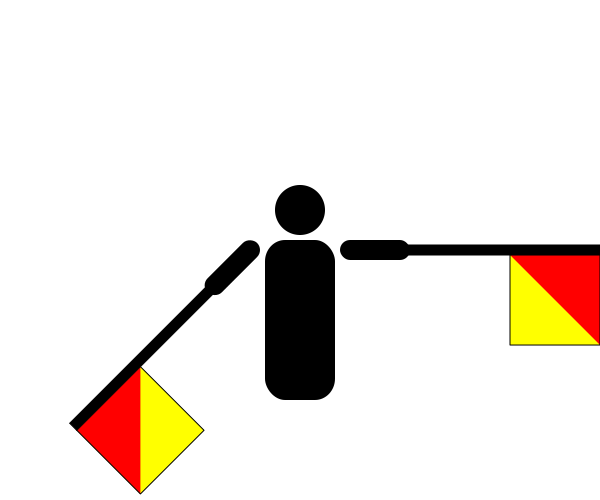

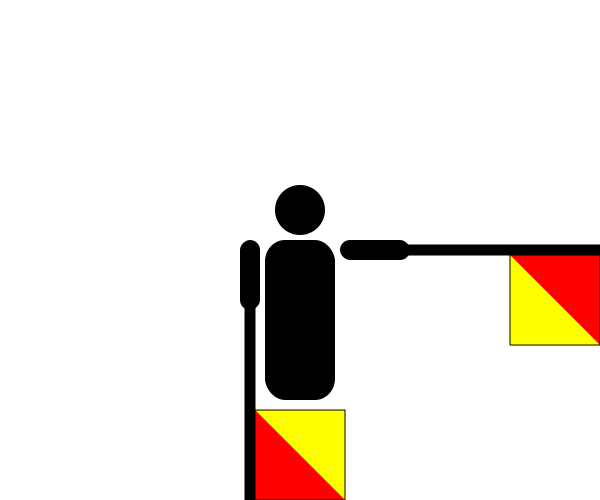


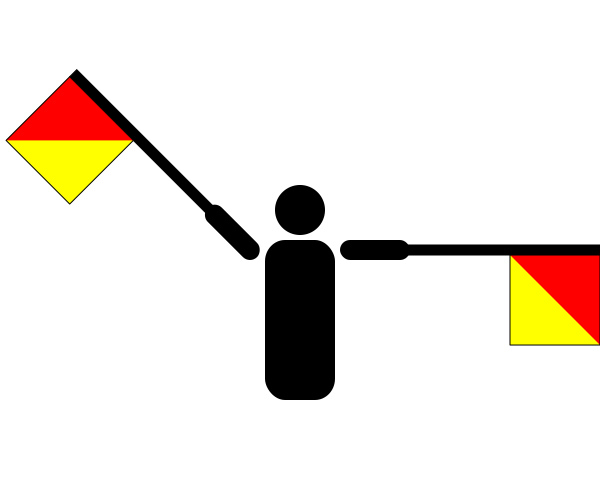

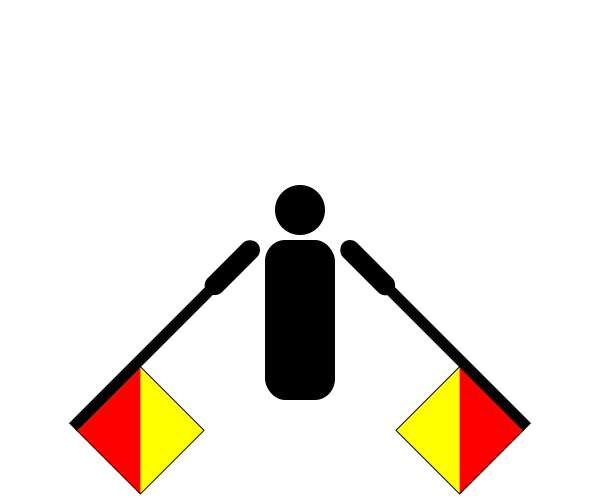
There are approximately 3,413 people named McFadyen in the UK. That makes it roughly the 2,676th most common surname in Britain. Around 52 in a million people in Britain are named McFadyen.
Surname type: From name of parent
Origin: Celtic
Region of origin: British Isles
Country of origin: Scotland
Religion of origin: Christian
Language of origin: Gaelic