MCDERMID
Recorded variant spellings include Mc Dermid, Mcdermid
McDermid is a surname of Celtic origin, found primarily within the British Isles, and particularly in Scotland and Ireland. The name derives from the Gaelic MacDhiarmaid, which literally translates to “son of Diarmaid.” The personal name Diarmaid is itself composed of elements meaning “without enemy” or “free from envy,” and it has been used in Irish tradition since the early medieval period.
Historical records indicate that the earliest known bearer of the surname was Brian Mac Dermot, the former owner of the Annals of Lough Ce. He is recorded in the Scottish Church Registers, having married Isabella Brown on 23 July 1857 at Glenmuick, Aberdeen. The first printed spelling of the name remains that of Brian Mac Dermot, who died in 1592 at Moylurg, Ireland, during the reign of Queen Elizabeth the First.
The McDermid name also appears in Irish heraldry. The Mac Dermot chief is recognised by the Irish Genealogical Office and is entitled to be called The Mac Dermot. He bears the title Prince of Coolavin, and two principal branches of the family traced their roots to the counties of Sligo and Roscommon, where the territories were known as “Mac Dermot’s County.” The name thus evokes a line of descent from a 12th‑century Connachta king and from the High Kings of Ireland who reigned jointly in the mid‑7th century.
In Scotland the surname is linked to the ancient Dalriadan clans of the west coast and Hebrides. It is traditionally associated with the region of Argyll, where the Clan MacDermid – also known as Clan Campbell of Inverawe – is believed to have originated. Over the centuries a variety of spellings have appeared, including McDiarmid, MacDiarmid, McDermott, and others, reflecting the way scribes recorded pronunciation at the time.
Emigration from Scotland in the 19th and 20th centuries spread the name throughout the United Kingdom, the United States, Canada, and Australia. While the surname remains most common in Scotland, particularly in the former province of Argyll, it is now found in many countries with Scottish diaspora communities. Variants such as Dermott and Dermot are sometimes seen, and the related surnames O’Diarmada and O’Dermody share the same Gaelic root.
The meanings attached to the surname are generally approximations. While MacDhiarmaid is often translated as “son of the free man,” literal interpretations of the individual elements can vary, and the significance of the name should be understood in a historical rather than a definitive linguistic sense.
Typical given names associated with the McDermid surname
Male
- Alastair
- Andrew
- Daniel
- David
- George
- James
- John
- Neil
- Paul
- Peter
- Robert
- Thomas
- William
Female
- Angela
- Anne
- Catherine
- Deborah
- Elizabeth
- Helen
- Jacqueline
- Jean
- Leona
- Margaret
- Mary
- Nicola
- Sally
- Susan
Similar and related surnames
Related and similar names are generated algorithmically based on the spelling, and may not necessarily share an etymology.
How to communicate the surname McDermid in...
Braille
⠍⠉⠙⠑⠗⠍⠊⠙
Morse
---.-.-....-.--..-..
Semaphore
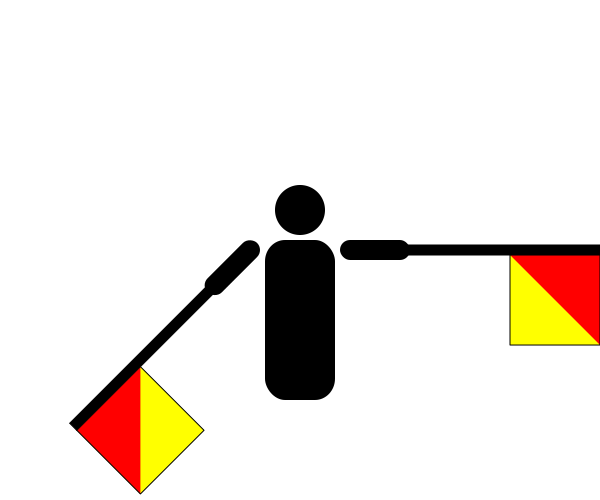


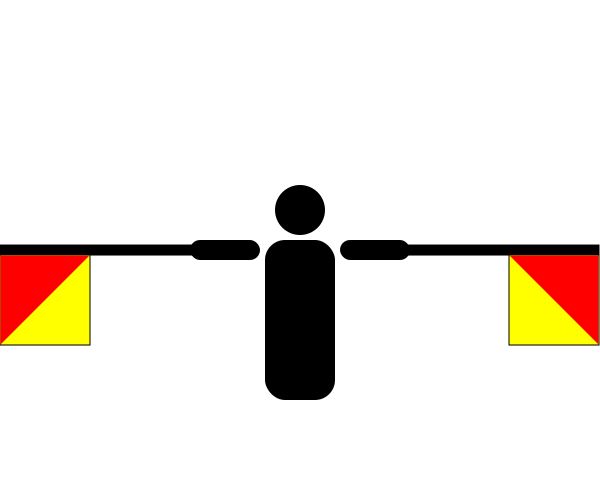
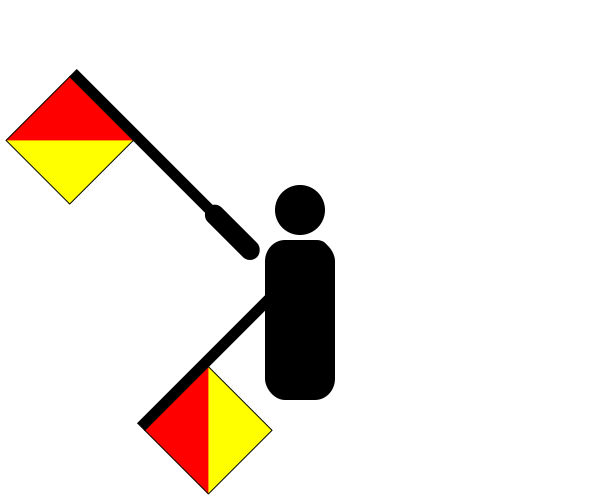
There are approximately 1,189 people named McDermid in the UK. That makes it roughly the 6,466th most common surname in Britain. Around 18 in a million people in Britain are named McDermid.
Surname type: From name of parent
Origin: Celtic
Region of origin: British Isles
Country of origin: Scotland
Religion of origin: Christian
Language of origin: Gaelic

Famous people named McDermid
- Val McDermid - Scottish crime writer
- Angus McDermid - (1921 to 1988)
- Sally McDermid - Australian softball player
Names and descriptions courtesy of Wikipedia, and may contain errors. This is not intended to be an exhaustive list of every famous person with this name.